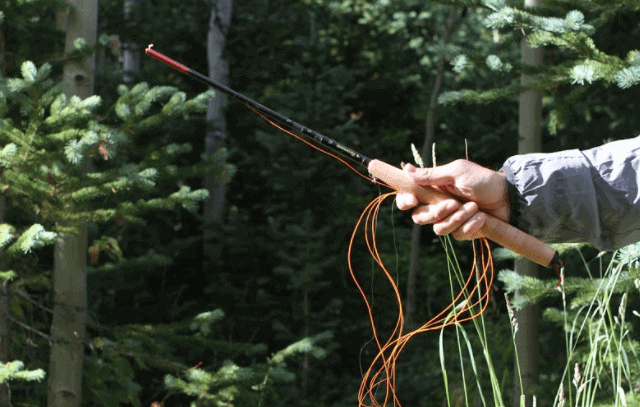
The Tenkara USA guarantee means we’ll make sure your tenkara rod bearing our name gets fixed quickly and conveniently. Do not mail anything back to us, we will send you just the part(s) you need for your tenkara rod. […]
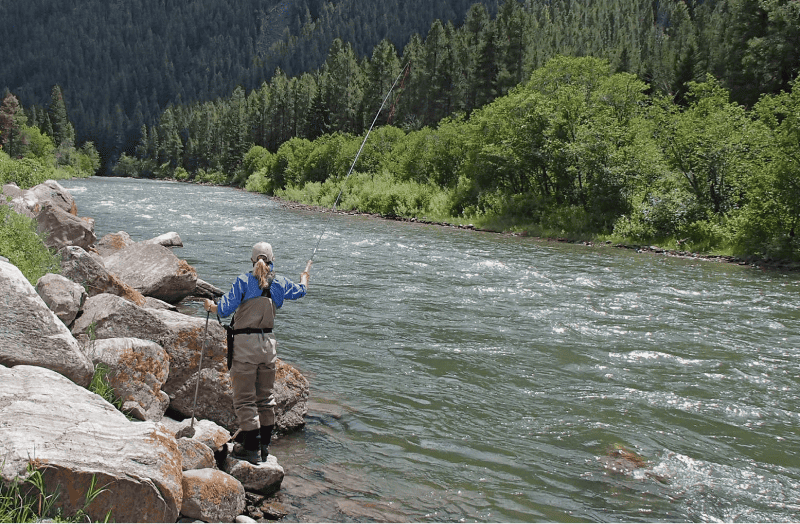
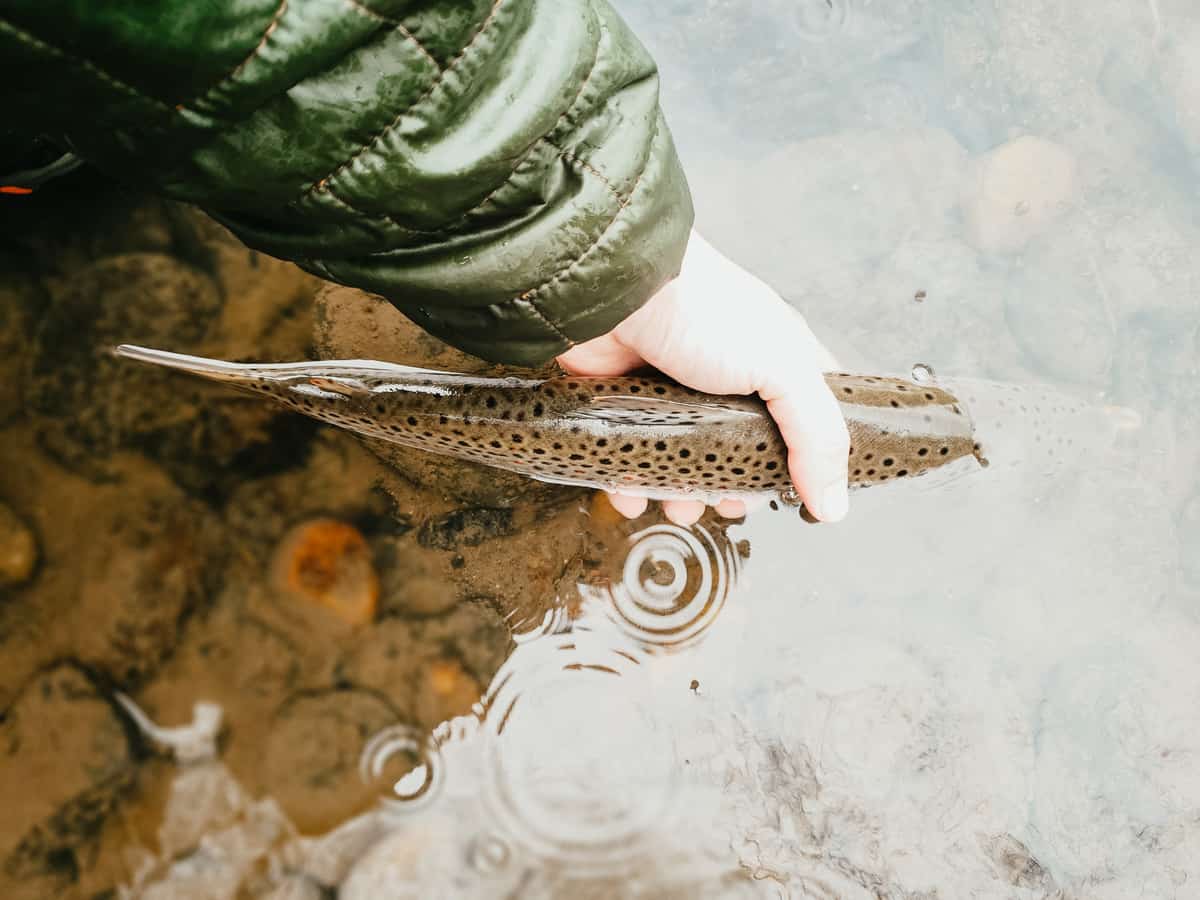
John Geer and I went to Missoula, Montana to attend the Orvis Guide Rendezvous over the last couple of days. We were invited to share tenkara with the Orvis network of guides, since they will likely be getting a lot of inquiries about tenkara rods and the tenkara method of fishing now that we are being featured on a full page of the Orvis catalog. We had 2 hours yesterday to sneak out and fish the nearby rivers. You have to watch the video to see the enormous fish John is holding at the end, he says it felt like a kayaker was pulling him.
Tenkara rod: Tenkara USA Amago
Tenkara line: 4.5 level line
Tenkara fly: Oki Sakasa Kebari
Tenkara net: hands and teeth!
We put our name on our rods for a simple reason, we stand behind each one of them. In our short existence we have established a new and tough-to-follow standard when it comes to the warranty process of a fishing rod, and I may even say it is likely the best warranty process in the industry.
Most of our products go through minor iterations and revisions on a regular basis. We follow the Japanese philosophy of kaizen, or continuous improvement, and are constantly making the rods, lines and flies better. Many of these changes, we will never announce. But, today we’re releasing what is essentially a brand new rod, and worthy of your attention: The 13ft Ayu Series II, a redesign of one of the most popular tenkara rods around. This rod is a direct result of my last trip to Japan, which was followed up by a week spent with our factories and engineers in China to ensure we built the best tenkara rods possible.
The Ayu has gone through at least two different iterations over the last 3 years. We originally changed the handle, which used to be flat, to a contoured and more ergonomic handle. On a subsequent iteration we improved its strength and smoothed its bend. Now, we changed it enough that the 13ft Ayu is a very different tenkara rod.
In creating (and tweaking) a tenkara rod I pay particular attention to four criteria I feel are most important for a good tenkara rod: it must cast well (precisely and effortlessly); it must feel comfortable to be cast all day long; it must set the hook well; and it must play fish well.
For the current version, I wanted to strengthen the Ayu a bit more and make it capable of more easily landing some of the larger fish people have been catching. The previous Ayu, I started realizing, was a bit too soft; this made casting with it a delight, but landing some of the larger fish took a bit longer than ideal – Not that it couldn’t handle good size fish! I also did not want to lose the soft feel of the rod, which was the original vision for the Ayu. It is a rod that reminds many people of a fiberglass rod or a bamboo fly rod, and I did not want to let that go, many of our customers love the Ayu for that reason. We kept most of the original Ayu there, but gave it slightly more “backbone”, and also made it into a 6:4 tenkara rod. This change gives it a crisper feel (it recovers faster and makes casting more precise. Moving to a 6:4 rating also allows us to get away from a rating system that adds complexity into something meant to be simple. Our goal, going forward, will be to have the best tenkara rods, but eliminate too many decision making aspects to trying tenkara.
This photo shows our first iteration of the Ayu
The new Ayu still casts beautifully, effortlessly, but now also with much more precision. It will also handle fish much more easily, yet feel great when a smaller fish is caught. It is not as robust or as heavy as the 13ft 6inch Amago tenkara rod. Nor as light as the shorter Iwana. It is simply a great tenkara rod.
I felt these changes warranted a change to the look of the rod. Typically I like to keep the look of the rod the same. People start recognizing the rods by their stripes. Essentially we start building some “model equity” into them. People will certainly remember the recognizable green stripes of the old Ayu, and letting that go wasn’t an easy decision. But, in the end we also found a finish that would be more durable, and would, as one of the first people to see it said, “look sexy”. The new Ayu has a carbon scrim look at the handle, and clear carbon look throughout the rod. You can see the quality of the rod thorough its entire length. I realized there was no need to hide something that is well done, and you can see the uniformity in the carbon behind the finish and be assured we have taken every step in ensuring the quality is good.
And, lastly, a small detail worth noting that we’ll be phasing in for all our future rods. We’re starting to connect a segment of lillian (the hollow braided material that makes up the tip of tenkara rods), to the plug of the rods. This serves two functions: (1) it makes it easier to keep track of where the plug is, and/or connect it to your shirt/vest/fishing bag, and (2) it can be used for field repairs should you ever break the tip of the rod.
*PLEASE KEEP IN MIND PREVENTING BREAKAGE IS VERY EASY: Just put the hard tip inside the rod and put your finger on top of it as you tie or untie the line.
The Ayu is currently only available for shipping out of the USA (USA, Australia, South America, Asia and Africa), we’ll soon stock it in Europe as well. For those in Europe, we have a great deal going on for the Series 1 Ayu here, until supplies last.
Today is day 4 of spending time with our factories in China. It was a very productive day. Margaret joined me in evaluating working conditions at the factory that makes the Yamame rods for us. She provided a keen eye for detail; requesting that workers put on their mask even as they may not like doing it and those are available to them. A good portion of the day was dedicated to teaching tenkara to our rod engineers and evaluating rod designs and processes to ensure good quality control going forward.
I don’t have a whole lot to write about today. Normally this would be a quick writeup with pictures posted on our socialnetworks/microblogging platforms, but unfortunately I do not have access to those where I am. I will leave it at that so I don’t lose access to this blog as well.
I have been in China for about 3 days now (5 more to go), following a 2-week long stay in Japan. This tour of Asia is very important and I believe will translate into ever-better Tenkara USA products. And, I’m already seeing concrete insights and results from being here.
For about 4 years I have focused on developing authentic tenkara rods. I do not copy any rods and have my own design philosophy when it comes to making (and releasing) new tenkara rods. Futher, for the last 4 years I have been taking your feedback into account into everyone of our rods. As you can see, I brought all those notes here with me.
AH! Tenkara rod caps. A necessary evil; a love-and-hate relationship with some; a piece destined to be lost by others. Couldn’t there be a solution that is more versatile and less prone to being lost?
We just received shipment of the “Universal Tenkara Rod Caps”. I think some of your may really like it. They are available here.
This little piece of gear will offer the following benefits:
1) It fits any tenkara rod
2) The line can stay attached to the rod tip with it (just be careful when removing it so the tip doesn’t come out and snap)
3) It’s easier to keep track of and may be even wrapped around the rod itself while fishing.
4) It offers better protection for the end of the rod.
An interesting note, Jason Klass of Tenkara Talk discussed this product on this post. Unbeknownst to him I had placed an order for this item almost exactly 24 hours before his post went up! Now, his wish and those of others in his blog have been answered.
By the title of this post, you know there is something disgusting to come, and I’ll save that for the end. The last couple of days were very enjoyable, with some great experiences. A bit too much for a single blog post, but I want to stay on top of it and write as the memory is fresh. We are going fishing for ayu in about 20 minutes (if the rain stops, that is), so please forgive any errors. And, by the way, there are pictures of fishing at the end.
The main plan for yesterday was to meet with a renowned rod maker. We started our trip early as Dr. Ishigaki mentioned he wanted to show me a fishing store in the area we would be visiting. Visiting this second fishing store was certainly worth the stop. As we parked the car, it was instantly clear this was a fishing store. There were fish prints everywhere on the windows. Upon closer inspection I realized they were all gyotaku prints. If you’re not familiar with gyotaku here is a good introductory post.
I wondered what that was all about. Was it from customers trying to show their catch in an artistic way (similar to the fish photos we may see in stores elsewhere)? Were gyotaku particularly popular in this area? There were dozens and dozens of them (probably the low hundreds) and the inside of the store was adorned with more of them. While the outside featured gyotaku prints of trout and ayu (a local species of fish), the inside had larger fish such as tai and tuna, printed on beach-towel-sized paper. I didn’t think much about it and went on to browse all the cool things they had there, a great variety of hooks for ayu and tenkara, as well as ayu rods, and of course their tenkara rods. Margaret, not as interested as I am in all the fishing tackles, started a conversation with an older man who worked at the store. Soon she learned he was the person behind each one of the gyotaku prints we saw. His name is Akira Yokota.
I should probably have asked more questions – such as how long he’s been doing it – regretfully I didn’t. But, we did learn that customers from the region came to him with their fish in hand to record their catch and that a couple were caught with tenkara. It is, after all, similar to how we see pictures of fish on the walls of fishing stores elsewhere – just a little different.
The second part of the day was the meeting with a rod maker and his staff. The meeting was very productive though I’ll have to save you from that boring stuff. The real exciting part happened about half-way through the meeting. I saw the rod maker stepping out of the room and coming back with a tenkara rod in his hand. As I was engaged in a conversation with the rest of his staff, I didn’t pay any attention to it. Until, out of the corner of my eye, I caught a glimpse of a couple of unique features of the rod. I recognized it instantly.
A couple of months ago I was visiting Montana (and fishing of course) and learned the FFF museum in Livingston had a couple of tenkara items in their exhibit. Obviously that became a mandatory stop. There it was, a full tenkara set of rod, line and flies, hanging on the wall. Here’s a picture of the set.
This was a very unique rod, with wooden ends on the handle area, and a leather-wrapped grip. It was also a short rod when collapsed. And, thus I recognized it easily and quickly.
I stopped in my tracks: “Ohhhh! I know this rod! Have you been to Montana?”. It turns out he had and that was the exact same rod! I pulled my cell phone out to show him the picture above. Needless to say he was happy to see that image. Unexpectedly he said that he brought the rod in because he wanted me to have it.He never expected such dedication to a method of fishing that most Japanese do not know about to come from the US. It was a esteemed rod to him, about 30 years old. He said he was planning to eventually give it to Dr. Ishigaki, but, especially after I showed him the picture, he thought I should have it. I am not sure what I will be able to do to thank him. This was a super special gift, he has no idea!
What are the chances?
The other highlight of day 3 was our dinner. In what is becoming a regular point of homage in my trips to Japan, we visited the Maruhachi ryokan. It is always a feast there and the ambiance very pleasant. This was Margaret’s first time and I was excited to finally bring her over. I could say the dishes even tasted better because of her presence, but the addition of “Uruka”, a.k.a. fermented ayu (fish) intestines to the menu may diminish the truth in that statement.
Ayu, a.k.a. “sweet fish”, is a type of fish found in the streams of Japan (as well as Korea, China and Taiwan). It’s a delicious fish and very prized for its delicate meat, with a subtle, and some say slightly sweet flavor. The ayu graze on algae that grows on rocks, and its guts are thus edible (some even think of the guts as a delicacy). Typically Ayu are cooked shioyaki-style (sea-salt coating the skin and roasted) and every part of it can be eaten.
Just when I had grown accustomed to eat natto (fermented soybeans, and ubiquitous in Japan) I am presented with something even gnarlier: fermented ayu intestines (uruka). Uruka is very rare and considered to be one of the top 3 most prized delicacies (“chinmi” – delicacies) in Japan. Yes, hard to fathom, I know! It was not nearly as bad as it sounds (I know it sounds VERY VERY BAD). It was very salty (shopai as Margaret says at the end of the video), and if I had to describe it I would say it was like oyster with lots of salt… and certainly not as appetizing.
Well, to finish on a more “appetizing” note, there is some fishing too! It has been very hot here, hovering in the 90s with super-high humidity. So, Dr. Ishigaki and I decided to have an early start today: 4:30AM. The river was right next to our ryokan and we only had to drive a few minutes to the spots we wanted. But the early start proved to be crucial – though not in terms of fish, he and I only caught one each between 5:00 and 7:00.
Here are a few images of fishing this morning on the Mazegawa and then one of the tributaries:
We didn’t catch this one, but here is a recent Iwana taken out of the Mazegawa and put in the Fishing Center’s aquarium, what a way of raising hopes of poor anglers. It certainly makes me want to go fishing early tomorrow. It was roughly 20 inches long.
Yesterday several of you requested to learn more about the different telescopic rods available in Japan. There is an incredible variety of fixed-line methods of fishing in this country. Different telescopic rods which are designed and manufactured with specific purposes in mind. Yet, these are largely unfamiliar to most people.
Based on your requests, I decided to revisit the Sansui store in Tokyo today. I changed some plans, took a long bus ride, then a subway ride and walked for about 15 minutes in sweltering heat with a camera hanging on my neck just for you! I showed up at the Sansui store which specializes in fixed-line methods of fishing to give you an overview of the different telescopic rods used for fresh-water fishing. Please keep in mind that even though I show you about 9 different types of rods in this video, there are probably twice as many kinds of telescopic rods. Hopefully this will help clarify a bit what the different rods are made for: not all telescopic rods are created equal. Please forgive if the quality of the video is not that great or if there are no subtitles, but this was shot just a few hours ago, and the editing done quickly.
As for the rest of the day: after visiting Sansui it was time to take the bullet-train down to Nagoya where Margaret and I would be visiting Dr. Ishigaki.
We spent a good amount of time at his “tenkara-heya” (tenkara room). I was in awe at his collection of old and new tenkara rods, tenkara nets, tenkara flies and other relics. It was quite a treat to spend time there. We discussed rod design, going through 30+ year old tenkara rods and the modern ones as well as prototypes I’ve been working on. And, we talked about all the flies he had displayed in his “tenkara museum”. Here are a couple of pictures from this evening:
A 30+ year old box of tenkara flies that Dr. Ishigaki cherishes.
We joined Dr. Ishigaki and his wife at their home for a delightful dinner consisting of several small dishes (which is by the way one of my favorite things about Japanese cuisine and my favorite way of eating – as long as I don’t have to do the dishes).
Time to hit the hay now, for a day of meetings and travelling tomorrow.
Tomorrow morning I will be heading to Japan for my 4th visit. It is part of a journey I have so far called “my search for tenkara”. On my first visit I discovered the method (and as a result decided to introduce it outside of Japan). My second visit served to learn the techniques and what makes tenkara a complete method. The third visit, 2 months spent in a mountain village, allowed me to dive deeply into tenkara. I have met, interviewed and fished with several of the long-time masters of tenkara, learning directly from them what tenkara is. I also spent time with some of the so-called “3rd generation” of tenkara anglers, young tenkara anglers that have been pushing the sport forward (albeit in much subtler ways than what we may see here).
As I prepare my suitcase and finalize my schedule, I have to ponder, what else is there to seek? What else can I learn about tenkara? What are the things that would be of interest to the readers of this blog?
Although what I learn and share about tenkara can be seen as a “business”, this trip like all others are part of a personal journey. Everything I do, I do because it interests me greatly on a personal level. What I experience, what I learn, and what I capture are as much for my own enjoyment and self-enrichment as for sharing. I visit Japan and fish with long-time practitioners of tenkara because I like sharing tenkara as it is practiced in its country of origin. I am not good at inventing new things, tinkering with accessories, or making up a new method. I much prefer to tell a story, and to share what is waiting to be shared.
I have scheduled time to fish and spend time with teachers and friends. I have also scheduled time to visit tenkara rod makers, tenkara line suppliers, and even tenkara fly tiers. I have also scheduled time to simply fish. And, finally, I have made sure I have time that is not scheduled, which will allow tenkara to take me where it will. I’ll try to share as much as I can throughout the trip.
As I prepare to embark on this trip, I have to ask you, what are the things you’re most interested in learning? Seeing? Reading?
The number one question we are asked by new tenkara anglers is, “which rod should I get?” It certainly can be confusing since tenkara rods come in different lengths and actions. We always like to tell people that they really can’t go wrong, any rod will work just fine. But, in order to assist you with understanding what our rods are designed for, we have put together the video below with Daniel walking trough the entire lineup of Tenkara USA rods. We have also put together the chart below the video, which we hope will help with the decision making process and some pointers about the key aspects of tenkara rods.
Since all Tenkara USA rods will work for most trout fishing and smaller fish scenarios it’s hard to pin each one down to a specific use or to match your exact preference. Further, we believe people will just grow into the rod they get anyways.
It was never our intent to make things more confusing, nor necessarily for people to buy multiple tenkara rods when we developed the 6 rods that are in our current lineup – as a small company things would be MUCH simpler if we only had to worry about managing inventory of one rod model. But, each of the rods in our lineup were developed to fill a specific niche or preference. However, there are certain applications where we believe each model shines and the following table attempts to simplify the rod selection process:
Three Easy Choices
If you wish we offered fewer options, you can easily narrow the choices down to 3 “all-arounder” rods: the 13ft-14ft7in Ito, the 13ft Ayu, and the 12ft Iwana.
These rods are very easy for us to recommend, with the other rods in the lineup being considered more “specialty” tenkara rods.
The main difference between the Ito, Ayu and 12ft Iwana will be their length. So, if you fish wider streams and are looking for an excellent premium rod the Ito will be a great choice. If you’re fishing wider streams but don’t want to spend as much money on the rod, the 13ft Ayu is a great option. And, if you fish a mix of stream sizes, the 12ft Iwana is a great no-brainer.
If in doubt: just get the 12ft Iwana.
Bigger Fish – two more choices
We have developed two rods with more backbone if you’re always catching fish that are 17″ (43cm): the 12ft Yamame and the 13ft 6in Amago have more backbone and make landing the larger fish a bit easier. The main difference between the two is their length, with the Amago being a better rod for larger and more open streams, and the Yamame being the best tool for smaller streams.
Smaller Streams – one more choice (erhh, two actually)
The last choice in our lineup is if you’re fishing pretty small streams all the time. In that case we offer the 11ft version of the Iwana. You’ll have less reach, but if you’re fishing tighter streams that will be a good choice.
Actually, if you get the Iwana, you also have the option of purchasing a separate add-on handle to transform your rod into its shorter cousin. We only recommend you take advantage of this option after you have been fishing with tenkara for sometime and REALLY wish you had a shorter rod. In our experience it just takes a little getting used to the longer rods, but once you’re used to them they will likely work well.
Some further thoughts on what how we make our recommendations
Length, start here
The first question you should ask yourself is which length is right for the majority of fishing you plan to do. Generally speaking, we always recommend using the longest rod you can get away with. This will give you more reach, help you keep more line off of the water and give you more control over your fly (one of the main benefits of tenkara).
A 12ft (360cm) tenkara rod is a very standard length for tenkara. But, if you live near pretty small streams with low, overhanging branches, then a shorter tenkara rod (say 11ft / 330cm) might let you cast more easily under the canopy.
In either case, you should target your rod choice toward the waters you’ll fish the most. AND, keep in mind a longer rod will have the added versatility of giving you reach in more open sections of a stream, while having the ability to be “fished shorter” by holding the rod above the handle and potentially even collapsing one segment. Further, pairing a long rod with a short line is a very effective combination in smaller streams. Both Jason and I usually fish a 13ft tenkara rod (even on small streams) and you might be surprised how well it fishes in pretty tight quarters.
Action, this is more subjective
Action is primarily a personal preference. Some people prefer stiffer rods, while others prefer softer actions. There is no right or wrong here.
We tend to prefer softer rods (5:5 or soft 6:4) because they load easily, making for very effortless casting. Softer rods will also protect tippet well. Our rods will lean towards the softer end of the scale as we believe they are the best tool for tenkara. Two of our 6 rods are stiffer. The stiffer rods will often have more backbone to put pressure on large fish and will be better at precise casting at short distances (though this can be made up for with technique and practice). The Yamame and the Amago, are both stiffer and also have a good deal of backbone and were designed with larger fish in mind.
Tenkara rods are relatively soft compared to western fly rods, and all our rods have soft tips to assist in casting very light lines. So if you’re used to a fast-action western-style fly rod, you might prefer a slightly stiffer action tenkara rod like the Iwana 6:4, the Yamame 7:3 or the Amago 6:4.
Fish Size, last consideration
All tenkara rods are made for the average trout and other smaller species of fish: 8″ – 18″ (20 – 45cm).
All tenkara rods will handle the occasional 20+ incher (50cm +). So, if your targeted fish size is within those ranges, fish size should have little bearing on the rod choice: ANY ROD WILL WORK FINE.
If you’re constantly catching fish that are over 17 inches (43cm), then we have two tenkara rods that have more backbone (stiffer and with more mass): the Yamame and the Amago. We consider those more specialty rods and they sell very well in places like Montana and Idaho.
With each rod being so versatile, it would be hard to make the “wrong” choice. Hopefully, the chart and video above will help. If you’re still struggling with which rod is right for you, feel free to post here, or email Jason at Jason@tenkarausa.com. He will be happy to help you make the best decision on your first tenkara rod.