The Tenkara USA guarantee means we’ll make sure your tenkara rod bearing our name gets fixed quickly and conveniently. Do not mail anything back to us, we will send you just the part(s) you need for your tenkara rod. […]
Two years ago I spent 2 months in the small mountain village of Maze, Japan. I was seeking to learn all I could about tenkara in what could be considered the cradle of this method of fishing. Stories of my visit to Japan (and anything Japan related) can be found here. But, I was often disheartened by the unsustainable approach to sport fishing in most streams and rivers in Japan.
Streams and rivers in Japan are treated as put-and-take fisheries, where the cost of the fishing license for a particular stream is often compared to the cost of fish in the market and seen as a cost to be recouped by keeping as many fish as will pay for the license. This is obviously not sustainable, as it was made clear when we had to load buckets of fish onto a section of the Maze river (Mazegawa) in preparation for a fishing class.
I have taken it on as a side project to inspire change in the way Japan thinks about its rivers in a modern society. I feel indebted to the Maze village and the Mazegawa, where I was hosted with open arms for 2 months. That is where I’m starting. I can can see there is a very long road ahead, and this will be a lifelong project, but I was encouraged when I was asked to write for the local newspaper what my thoughts for the Mazegawa were. It was published a few weeks ago and I just received my copy with “Part 1″ of a series of articles I plan . I’ll share the article I wrote below.
I have been in China for about 3 days now (5 more to go), following a 2-week long stay in Japan. This tour of Asia is very important and I believe will translate into ever-better Tenkara USA products. And, I’m already seeing concrete insights and results from being here.
For about 4 years I have focused on developing authentic tenkara rods. I do not copy any rods and have my own design philosophy when it comes to making (and releasing) new tenkara rods. Futher, for the last 4 years I have been taking your feedback into account into everyone of our rods. As you can see, I brought all those notes here with me.
By the title of this post, you know there is something disgusting to come, and I’ll save that for the end. The last couple of days were very enjoyable, with some great experiences. A bit too much for a single blog post, but I want to stay on top of it and write as the memory is fresh. We are going fishing for ayu in about 20 minutes (if the rain stops, that is), so please forgive any errors. And, by the way, there are pictures of fishing at the end.
The main plan for yesterday was to meet with a renowned rod maker. We started our trip early as Dr. Ishigaki mentioned he wanted to show me a fishing store in the area we would be visiting. Visiting this second fishing store was certainly worth the stop. As we parked the car, it was instantly clear this was a fishing store. There were fish prints everywhere on the windows. Upon closer inspection I realized they were all gyotaku prints. If you’re not familiar with gyotaku here is a good introductory post.
I wondered what that was all about. Was it from customers trying to show their catch in an artistic way (similar to the fish photos we may see in stores elsewhere)? Were gyotaku particularly popular in this area? There were dozens and dozens of them (probably the low hundreds) and the inside of the store was adorned with more of them. While the outside featured gyotaku prints of trout and ayu (a local species of fish), the inside had larger fish such as tai and tuna, printed on beach-towel-sized paper. I didn’t think much about it and went on to browse all the cool things they had there, a great variety of hooks for ayu and tenkara, as well as ayu rods, and of course their tenkara rods. Margaret, not as interested as I am in all the fishing tackles, started a conversation with an older man who worked at the store. Soon she learned he was the person behind each one of the gyotaku prints we saw. His name is Akira Yokota.
I should probably have asked more questions – such as how long he’s been doing it – regretfully I didn’t. But, we did learn that customers from the region came to him with their fish in hand to record their catch and that a couple were caught with tenkara. It is, after all, similar to how we see pictures of fish on the walls of fishing stores elsewhere – just a little different.
The second part of the day was the meeting with a rod maker and his staff. The meeting was very productive though I’ll have to save you from that boring stuff. The real exciting part happened about half-way through the meeting. I saw the rod maker stepping out of the room and coming back with a tenkara rod in his hand. As I was engaged in a conversation with the rest of his staff, I didn’t pay any attention to it. Until, out of the corner of my eye, I caught a glimpse of a couple of unique features of the rod. I recognized it instantly.
A couple of months ago I was visiting Montana (and fishing of course) and learned the FFF museum in Livingston had a couple of tenkara items in their exhibit. Obviously that became a mandatory stop. There it was, a full tenkara set of rod, line and flies, hanging on the wall. Here’s a picture of the set.
This was a very unique rod, with wooden ends on the handle area, and a leather-wrapped grip. It was also a short rod when collapsed. And, thus I recognized it easily and quickly.
I stopped in my tracks: “Ohhhh! I know this rod! Have you been to Montana?”. It turns out he had and that was the exact same rod! I pulled my cell phone out to show him the picture above. Needless to say he was happy to see that image. Unexpectedly he said that he brought the rod in because he wanted me to have it.He never expected such dedication to a method of fishing that most Japanese do not know about to come from the US. It was a esteemed rod to him, about 30 years old. He said he was planning to eventually give it to Dr. Ishigaki, but, especially after I showed him the picture, he thought I should have it. I am not sure what I will be able to do to thank him. This was a super special gift, he has no idea!
What are the chances?
The other highlight of day 3 was our dinner. In what is becoming a regular point of homage in my trips to Japan, we visited the Maruhachi ryokan. It is always a feast there and the ambiance very pleasant. This was Margaret’s first time and I was excited to finally bring her over. I could say the dishes even tasted better because of her presence, but the addition of “Uruka”, a.k.a. fermented ayu (fish) intestines to the menu may diminish the truth in that statement.
Ayu, a.k.a. “sweet fish”, is a type of fish found in the streams of Japan (as well as Korea, China and Taiwan). It’s a delicious fish and very prized for its delicate meat, with a subtle, and some say slightly sweet flavor. The ayu graze on algae that grows on rocks, and its guts are thus edible (some even think of the guts as a delicacy). Typically Ayu are cooked shioyaki-style (sea-salt coating the skin and roasted) and every part of it can be eaten.
Just when I had grown accustomed to eat natto (fermented soybeans, and ubiquitous in Japan) I am presented with something even gnarlier: fermented ayu intestines (uruka). Uruka is very rare and considered to be one of the top 3 most prized delicacies (“chinmi” – delicacies) in Japan. Yes, hard to fathom, I know! It was not nearly as bad as it sounds (I know it sounds VERY VERY BAD). It was very salty (shopai as Margaret says at the end of the video), and if I had to describe it I would say it was like oyster with lots of salt… and certainly not as appetizing.
Well, to finish on a more “appetizing” note, there is some fishing too! It has been very hot here, hovering in the 90s with super-high humidity. So, Dr. Ishigaki and I decided to have an early start today: 4:30AM. The river was right next to our ryokan and we only had to drive a few minutes to the spots we wanted. But the early start proved to be crucial – though not in terms of fish, he and I only caught one each between 5:00 and 7:00.
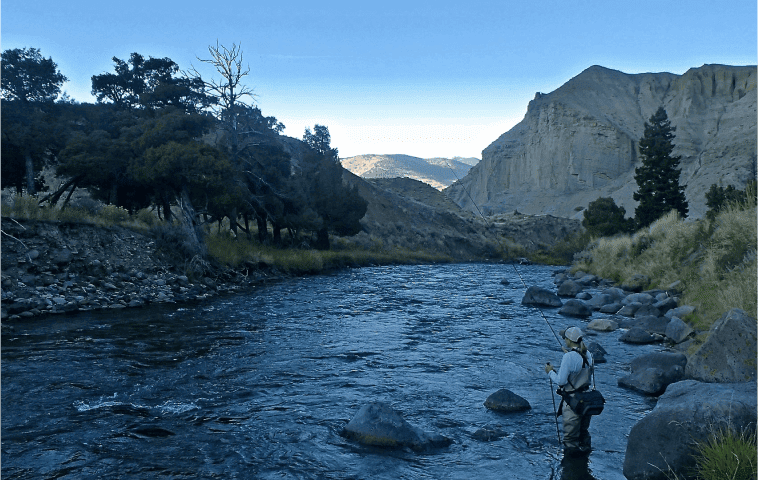
Here are a few images of fishing this morning on the Mazegawa and then one of the tributaries:
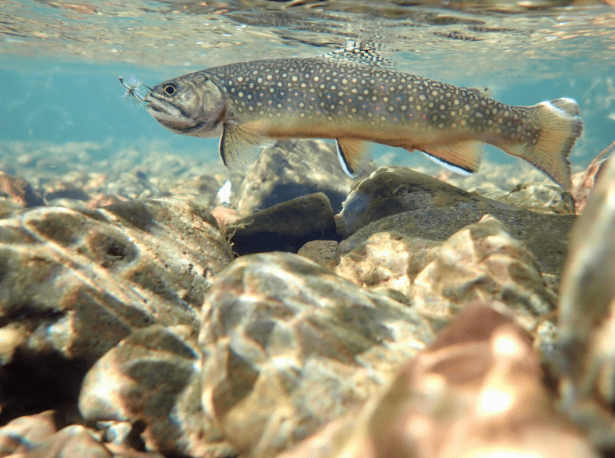
We didn’t catch this one, but here is a recent Iwana taken out of the Mazegawa and put in the Fishing Center’s aquarium, what a way of raising hopes of poor anglers. It certainly makes me want to go fishing early tomorrow. It was roughly 20 inches long.
Margaret and I decided to sit-out the 90 degree heat at a cafe, after an enjoyable day in Tokyo. It was an easy day, beginning with visiting one of my favorite shops in Japan – no, not a fishing store, but rather an excellent tea shop: Cha Ginza. They have the best tea I have ever tried and are a mandatory stop for when I visit Tokyo.
Bags of delightful sencha and new tea pots purchased as gifts, it was then time to head to our next stop: Hachiko’s statue at the Shibuya station.
The plan was to meet a longtime customer who started tenkara after finding our site a couple of years ago. He has since found in tenkara a new passion; “something that changed his and many other lives” as he says.
Our last stop were the Sansui fishing stores near the station. Sansui is a 110 year old fishing store, and they have 3 stores in the area, one dedicated to fixed-line fishing methods (tenkara, Hera, tanago, keiryu, and Ayu fishing), one for lure fishing and fly-fishing and one more focused on bass fishing. The visit was very pleasant. As I browsed the tenkara section, one of the sales clerks got very excited when he recognized my shirt, “Ahhh, Tenkara USA! Danieru?!?!”. He talked about how he had our site bookmarked an followed this blog. We talked about Dr Ishigaki and Mr Amano, whom he and another person at the store knew.
I held a tiny tanago rod in my hand, it was beautiful, about 12 inches when collapsed and 2.2 meters opened. I asked if I could use that for tenkara, they laughed heartily, shaking their heads and probably amused with the question.
We talked about all the telescopic rods available under that one roof. They sell rods of all lengths, sizes, weights and for several specific purposes. I mentioned how people tend to see any telescopic rods as tenkara rods, or assume tenkara rods are the same as bait-fishing cane poles. They asked if telescopic rods were not common and seemed to understand the difficulty in the task of teaching the differences.
Then, two “gaijin” (foreigners) entered the store looking for tenkara rods. They were from Italy and had been hearing about tenkara in recent times, a method similar to their own Pesca alla Valsesiana. They recognized me and I proceeded to teach them the bits of tenkara I could at the confined space.
Hopefully I will share some cool fishing stories, tenkara flies, and more soon. The dizzying speed of Tokyo makes me want to hop on the next train. Fishing can’t come soon enough.
Tomorrow morning I will be heading to Japan for my 4th visit. It is part of a journey I have so far called “my search for tenkara”. On my first visit I discovered the method (and as a result decided to introduce it outside of Japan). My second visit served to learn the techniques and what makes tenkara a complete method. The third visit, 2 months spent in a mountain village, allowed me to dive deeply into tenkara. I have met, interviewed and fished with several of the long-time masters of tenkara, learning directly from them what tenkara is. I also spent time with some of the so-called “3rd generation” of tenkara anglers, young tenkara anglers that have been pushing the sport forward (albeit in much subtler ways than what we may see here).
As I prepare my suitcase and finalize my schedule, I have to ponder, what else is there to seek? What else can I learn about tenkara? What are the things that would be of interest to the readers of this blog?
Although what I learn and share about tenkara can be seen as a “business”, this trip like all others are part of a personal journey. Everything I do, I do because it interests me greatly on a personal level. What I experience, what I learn, and what I capture are as much for my own enjoyment and self-enrichment as for sharing. I visit Japan and fish with long-time practitioners of tenkara because I like sharing tenkara as it is practiced in its country of origin. I am not good at inventing new things, tinkering with accessories, or making up a new method. I much prefer to tell a story, and to share what is waiting to be shared.
I have scheduled time to fish and spend time with teachers and friends. I have also scheduled time to visit tenkara rod makers, tenkara line suppliers, and even tenkara fly tiers. I have also scheduled time to simply fish. And, finally, I have made sure I have time that is not scheduled, which will allow tenkara to take me where it will. I’ll try to share as much as I can throughout the trip.
As I prepare to embark on this trip, I have to ask you, what are the things you’re most interested in learning? Seeing? Reading?
Every so often I’m reminded that outside perception is a double-edged sword. When perceived as a small, solely-owned entreprise that is run by one person with a mission, the community respects and rewards the entrepreneurial spirit, the underdog if you will, and roots for his success. When the small, solely-owned enterprise run by one person is rewarded and starts succeeding and growing some people may start perceiving it as a large corporation, “the man” if you will, that is out there for an ulterior motive.
Recently I read a couple of things out there, on the world wide web, that reminded me Tenkara USA may now be perceived by some as a large “Tenkara Inc.” that is out there to dominate the world. The perception of growth in a new market like tenkara can also bring about new competitors, vying to take a slice of the market being created. As new companies try to imitate our products, in some cases trying to market the “tool” while ignoring the “method” of tenkara, I’m reminded that leadership in a product category and growth presents its unique challenges, perception is probably the smallest but most vocal and to me the most personally disturbing.
A few days ago I started going through some of the pages of our website to update content. I noticed I had not updated the “About Tenkara USA” page in quite a long time. It contained a couple of paragraphs about Tenkara USA, what its mission is and the fact that we donate 1% of our revenues to environmental non-profits. I had written that page soon after starting Tenkara USA, more concerned about stating what Tenkara USA is I didn’t concentrate on sharing the story of who Tenkara USA is. Read the rest of this entry »
When John Gierach contacted us expressing his interest in tenkara, I had no idea his interest in Japanese culture would extend so far beyond the type of fishing we were introducing here. In 2010 I had the pleasure of spending a couple of days at his home, where I learned that in college he enjoyed Japanese literature, not long after became interested in bonsai, and then even tried making his own gyotaku.
“OK, yep its real. my middle daughter designed it for my bday.”
This was the response Brian Howerton gave me when I asked him about his tattoo. On his very first post to our forum, there was no “hello there”, or “is this really fly-fishing?”, just the image of his newest, very rad tattoo. An obvious sign of a passion for tenkara. One of the things I’m proudest of in the creation of Tenkara USA is the community developed around it. Not everyone posts on the forum, like Brian, whose first post was the shocker above, but I feel that every single customer we’ve had is out there talking about tenkara to their friends. The community is just awesome, and this is an incredible example of it.
As Brian explained, he and his daughter “did a three day backpacking trip in August, it was during that trip we discussed tattoo ideas while killing time in the tent I think. She designed this based on that talk with me just doing the general layout. She wanted it to look painted on with a brush, even tried to simulate brushstrokes.” On the top left you’ll find our logo – Brian, hope we make you proud to carry that in your arm forever! – then a very neat design of the sakasa kebari (reverse hackle fly) below it, and on the right side are markings from 9 to 18 inches, which is how he’s measured fish for many years.
Brian has been fly-fishing for 15 years and discovered tenkara 2 years ago when he “bought the Iwana because it will fit in my motorcycle mostly. First five minutes using it I caught a 17″ bow and loved it since. Take the darn thing everywhere I go where there is any chance for even a half hour of fishing.”
The tattoo is just the outward sign of his ambassadorship for tenkara: “I talk up Tenkara to anyone who will listen, got the bumpersticker on the jeep and the window sticker on my lunchbox. Handed out the Tenkara ‘ambasador’ cards the week I got them to any friend who fishes, only one bought a rod though. Kebari flies are my wallpaper on my facebook and work computers. Yea, Im addicted to it. ”
Pretty cool Brian, pretty cool! If you visit Japan you may not be allowed into their onsen (hot-springs), but this will definitely be a good conversation starter with any yakusa-turned-tenkara-angler over there.
P.S.: no, we did not pay Brian to get the tenkara tattoo, but will be sending him a gift!
So, you may be asking, where exactly in Japan did you go?
We spent most of our time in the Itoshiro River, which is located in the Gifu province, and what we may call the “tenkara capital” of Japan. We also visited the Mazegawa, which was a beautiful river, but a bit high when we came. Gifu has a enormous variety and number of streams that are “tenkara-perfect”. See the interactive map below for exact locations where our pictures were taken.
Japan presents a few challenges for travelling, mainly the language and signage, which in some places is completely in Japanese characters. However, that is a minor detail in light of the best public transportation system in the world, and the fact that most people are very willing to help. Of course, in this trip I had the help of a good friend from Japan and Dr. Ishigaki was driving us around. To get to that area we took a Shinkansen from Tokyo to Nagoya, from there a subway ride to meet Dr. Ishigaki near his University, and a 3 hour car ride to the Itoshiro.