Warehouses in the USA and the UK for shipping within the European Union quickly and with no customs.

FAQ - Choosing a Tenkara Rod - Forum

About Tenkara Tenkara Rods tenkara lines tenkara videos tenkara flies

May 22 2013

Look Both Ways Before You Cross The Road River

Look Both Ways Before You Cross The Road River
by TJ Ferreira

Remember that old saying that your mother would tell you,”make sure you look both ways before you cross the road”? I have been hearing Ebisu lately from high in the heavens telling me the same thing when I enter a river to go play with trout. He has also told me I have much to learn.

Reading trout waters is something every tenkara angler must learn, and it is something I continue to work on. Learning to read the waters to spot where trout are likely to hold may be the difference between being skunked and catching fish.

I was fortunate to be able to fish with Daniel Galhardo and John Geer of Tenkara USA in Virginia during the Tenkara Summit 2013. I kept an eagle eye on them most the time trying to soak up fishing knowledge as we traversed the river. In the last almost 4 years I have learned a great deal on how to go tenkara fishing but I consider myself still an amateur at best. I know enough now to cast well enough, present a fly well enough, and to stumble on the rivers just well enough to, well…. catch trout. One thing I do know is that I have a long way to go before I can say I really know how to read a river well and that I am a seasoned fisherman.

Don’t get me wrong, I have come a very long way since starting tenkara back in 2010, but it is refreshing humbling to watch those that have fly fished for many years wade into almost any river and immediately start catching trout. When I go out on my solo trips, catching trout is always a bonus and in the last couple of years I have learned enough and fished often enough where I catch at least one trout every trip. It is a wonderful feeling knowing a kebari I tied and a cast that I made is catching many surprised trout where my tenkara rod takes me. But, there is always plenty of room for improvement and that means being humble enough to know one never really becomes a master of something, although some seem to get darned close. Maybe when I get to my 90s I will be decent enough.

For 2013, one of my goals is to keep up with my casting and try to continue to improve. I do well enough but with every 10 really good casts, I always have some bloopers on every fishing adventure. As the day progresses, I am either in a zone and kicking butt or there are days I get too tired and lazy and my casts go to pot. They may be good enough to catch fish but I am striving to do better anyway. My main goal now though is better reading of trout waters. I have a number of books on just this subject and they have been very helpful. Books like Reading Trout Waters by Dave Hughes and The Orvis Guide To Reading Trout Streams by Tom Rosenbauer are “must haves” for any tenkara fisher-person. But… the best place to learn how to read the trout waters is out on the water with friends that have more experience than you where you can watch them with an eagle eye and see what they are seeing.

I was able to use my eagle eye during the Tenkara Summit 2013 and was amazed at how well Daniel and John read the river. Daniel wanted to get some video of me catching and landing a trout and him and John said fish here. I proceeded to connect my line to my rod, telescoped the rod, and started making my way into the river. Half the way into the river I hear the Family Feud Buzzer going off in my head telling me, “hey dummy, why did you not make a few casts to the water you just walked through”? Looking back the odds were slim trout would have been where I had just walked to since the water was real fast, high, and the spot did not look fishy, but… it does not hurt making a couple casts anyway just in case.

I then proceeded to cast downstream into plunge pools and pockets I felt trout would be. I actually officially caught my first trout of the trip in that spot but the water was so fast I had the trout on for maybe 3 seconds before he popped off. I had my taste buds going though after that!

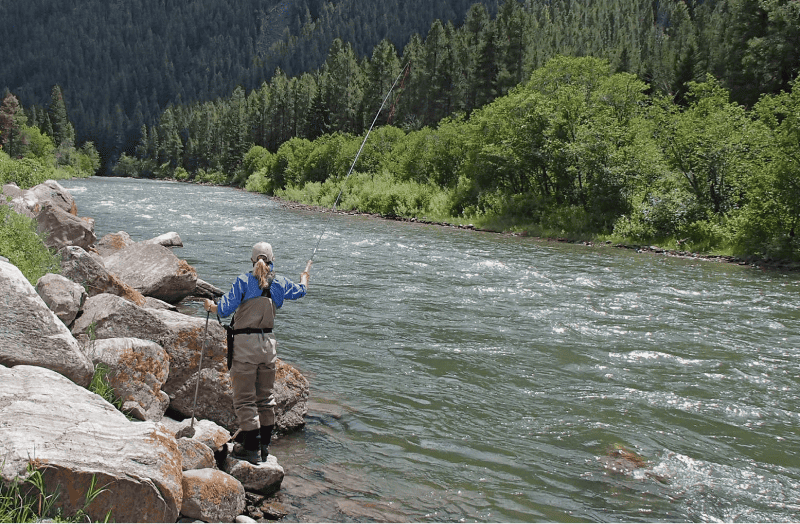
Daniel took a nice picture of me casting into an area trout would be and I have annotated the image to show some great spots where I cast to right away. Looking back at this image though there was a nice “slow water” area above the plunge pools I should have cast first. I was greedy though and went right for the picturesque pockets I felt my best chance of snagging my first brook trout. On this image I have marked it as “Try First” because I never did that day. I just waddled like a bull onto the water and started casting to the prime spots.


Prime spots where trout could be and where I should have tried first before entering the river.


The image I marked up does not mark all spots I feel trout are but you get the idea. The issue I wanted to point out is look first, both ways, and even up and down, before heading into the river. At a minimum, make a few casts to where you plan on walking out to just in case a sneaky trout is there waiting for some good bugs. After those first casts, look across from where you are standing and see if there are any other spots that may hold trout before really working that pristine spot. Of course do this quietly and effectively not to spook off the trout from that pristine spot that first caught your eye.

This blog is not a manual on how to read the water but to signal to you to look both ways before you proceed into the river. Read, analyze, enter, catch trout. Having watched Daniel heading toward some spots he felt trout were he kept casting as he approached that spot. During this time he is talking to John and I watching him as he looked back at us. Next thing we know he has a brookie on board (surprised him too), one of those sneaky ones that wanted to ride the good ship Tenkara Ito. Just went to show that keeping the kebari in the water and making casts to spots that may or may not hold trout, can make you head home that night not skunked. I don’t mind those accidental trout one bit.

If you take anything away from this blog post, keep this in mind. Cast to places you are about to tread on if you think they have any chance of holding a trout, and if you don’t think they do, cast there once or twice anyway. Next, look both ways, and even up and down, to see if there are any spots you can quickly and quietly make a cast to that may hold a sneaky little trout. These spots may reward you with a nice new friend. Most folks probably go right to the pretty water right away yet some of that uglier water may have some of the prettiest trout of the day.

Glad I listed to my mom when I was a kid and will remember to look both ways from now on.

Print

July 10 2012

Advantages of Zoom Rods

Written by Jason
Tenkara USA Ito

Zoom section of the Tenkara USA Ito showing its different lengths

Anyone who has followed my writing probably already knows that my tenkara rod of choice is the Tenkara USA Ito.  First and foremost, I love the action (I generally prefer softer rods) but my second favorite thing about it is that it’s a zoom rod.

If you’re not familiar with zoom rods, they are rods that can be adjusted to different lengths by simply sliding a section of the rod.  For example, the Ito adjusts from 13’ to 14’ 7”.  While tenkara rods are long by nature, they are already versatile enough to handle a variety of situations but zoom rods offer two unique advantages that I have come to really appreciate.

Read the rest of this entry »

Print

July 09 2012

How to Choose the Right Tenkara Rod

Written by Daniel & Jason 

The number one question we are asked by new tenkara anglers is, “which rod should I get?”  It certainly can be confusing since tenkara rods come in different lengths and actions. We always like to tell people that they really can’t go wrong, any rod will work just fine. But, in order to assist you with understanding what our rods are designed for, we have put together the video below with Daniel walking trough the entire lineup of Tenkara USA rods. We have also put together the chart below the video, which we hope will help with the decision making process and some pointers about the key aspects of tenkara rods.

Since all Tenkara USA rods will work for most trout fishing and smaller fish scenarios it’s hard to pin each one down to a specific use or to match your exact preference. Further, we believe people will just grow into the rod they get anyways.

It was never our intent to make things more confusing, nor necessarily for people to buy multiple tenkara rods when we developed the 6 rods that are in our current lineup – as a small company things would be MUCH simpler if we only had to worry about managing inventory of one rod model. But, each of the rods in our lineup were developed to fill a specific niche or preference. However, there are certain applications where we believe each model shines and the following table attempts to simplify the rod selection process:

Tenkara Rod Chart - Choosing a tenkara rod

Three Easy Choices

If you wish we offered fewer options, you can easily narrow the choices down to 3 “all-arounder” rods: the 13ft-14ft7in Ito,  the 13ft Ayu, and the 12ft Iwana.

These rods are very easy for us to recommend, with the other rods in the lineup being considered more “specialty” tenkara rods.

The main difference between the Ito, Ayu and 12ft Iwana will be their length. So, if you fish wider streams and are looking for an excellent premium rod the Ito will be a great choice. If you’re fishing wider streams but don’t want to spend as much money on the rod, the 13ft Ayu is a great option. And, if you fish a mix of stream sizes, the 12ft Iwana is a great no-brainer.

If in doubt: just get the 12ft Iwana.

Bigger Fish – two more choices

We have developed two rods with more backbone if you’re always catching fish that are 17″ (43cm): the 12ft Yamame and the 13ft 6in Amago have more backbone and make landing the larger fish a bit easier. The main difference between the two is their length, with the Amago being a better rod for larger and more open streams, and the Yamame being the best tool for smaller streams.

Smaller Streams – one more choice (erhh, two actually)

The last choice in our lineup is if you’re fishing pretty small streams all the time. In that case we offer the 11ft version of the Iwana. You’ll have less reach, but if you’re fishing tighter streams that will be a good choice.

Actually, if you get the Iwana, you also have the option of purchasing a separate add-on handle to transform your rod into its shorter cousin. We only recommend you take advantage of this option after you have been fishing with tenkara for sometime and REALLY wish you had a shorter rod. In our experience it just takes a little getting used to the longer rods, but once you’re used to them they will likely work well.

Some further thoughts on what how we make our recommendations

Length, start here

The first question you should ask yourself is which length is right for the majority of fishing you plan to do.  Generally speaking, we always recommend using the longest rod you can get away with.  This will give you more reach, help you keep more line off of the water and give you more control over your fly (one of the main benefits of tenkara).

A 12ft (360cm) tenkara rod is a very standard length for tenkara. But, if you live near pretty small streams with low, overhanging branches, then a shorter tenkara rod (say 11ft / 330cm) might let you cast more easily under the canopy.

In either case, you should target your rod choice toward the waters you’ll fish the most. AND, keep in mind a longer rod will have the added versatility of giving you reach in more open sections of a stream, while having the ability to be “fished shorter” by holding the rod above the handle and potentially even collapsing one segment. Further, pairing a long rod with a short line is a very effective combination in smaller streams. Both Jason and I usually fish a 13ft tenkara rod (even on small streams) and you might be surprised how well it fishes in pretty tight quarters.

Action, this is more subjective

Action is primarily a personal preference.  Some people prefer stiffer rods, while others prefer softer actions.  There is no right or wrong here.

We tend to prefer softer rods (5:5 or soft 6:4) because they load easily, making for very effortless casting. Softer rods will also protect tippet well. Our rods will lean towards the softer end of the scale as we believe they are the best tool for tenkara. Two of our 6 rods are  stiffer. The stiffer rods will often have more backbone to put pressure on large fish and will be better at precise casting at short distances (though this can be made up for with technique and practice). The Yamame and the Amago, are both stiffer and also have a good deal of backbone and were designed with larger fish in mind.

Tenkara rods are relatively soft compared to western fly rods, and all our rods have soft tips to assist in casting very light lines.  So if you’re used to a fast-action western-style fly rod, you might prefer a slightly stiffer action tenkara rod like the Iwana 6:4, the Yamame 7:3 or the Amago 6:4.


Fish Size, last consideration

All tenkara rods are made for the average trout and other smaller species of fish: 8″ – 18″ (20 – 45cm).

All tenkara rods will handle the occasional 20+ incher (50cm +). So, if your targeted fish size is within those ranges, fish size should have little bearing on the rod choice: ANY ROD WILL WORK FINE.

If you’re constantly catching fish that are over 17 inches (43cm), then we have two tenkara rods that have more backbone (stiffer and with more mass): the Yamame and the Amago. We consider those more specialty rods and they sell very well in places like Montana and Idaho.


With each rod being so versatile, it would be hard to make the “wrong” choice. Hopefully, the chart and video above will help.  If you’re still struggling with which rod is right for you, feel free to post here, or email Jason at Jason@tenkarausa.com. He will be happy to help you make the best decision on your first tenkara rod.

Print