Warehouses in the USA and the UK for shipping within the European Union quickly and with no customs.

FAQ - Choosing a Tenkara Rod - Forum

About Tenkara Tenkara Rods tenkara lines tenkara videos tenkara flies

March 16 2012

Tenkara Week – Idaho

This is Tenkara Week – Idaho.

For quite sometime I have thought of coming to Idaho, it just never seemed to work out in the past. Then, recently a very dedicated tenkara angler, John Ellsworth, convinced everyone here to bring me over for a presentation and clinics with Trout Unlimited’s Boise chapter (Ted Trueblood Chapter). John, with the help of Rick Williams, one of the owners of Idaho Angler and someone who totally gets tenkara (and is a huge conservation advocate) organized the week around tenkara. Thank you John and Rick, and TU for making this happen. It started off great.

Please read on for what kinds of techniques and flies worked best on yesterday’s outing.

Tenkara net fish

On Wednesday evening I gave a presentation to a packed room at the TU meeting. The presentation went pretty well and there was a great amount of interest aftewards. Prior to the presentation we spent sometime tying tenkara flies, and Carrie showed a couple of flies she had been tying.

tenkara fly tying

Yesterday, Rick and I were joined by Chris, the head guide at Idaho Angler, for a day of fishing on the Owyhee river, about an hour out of town. We had a nice break in the weather, with no rain and great temps.

Tenkara USA and Idaho Angler

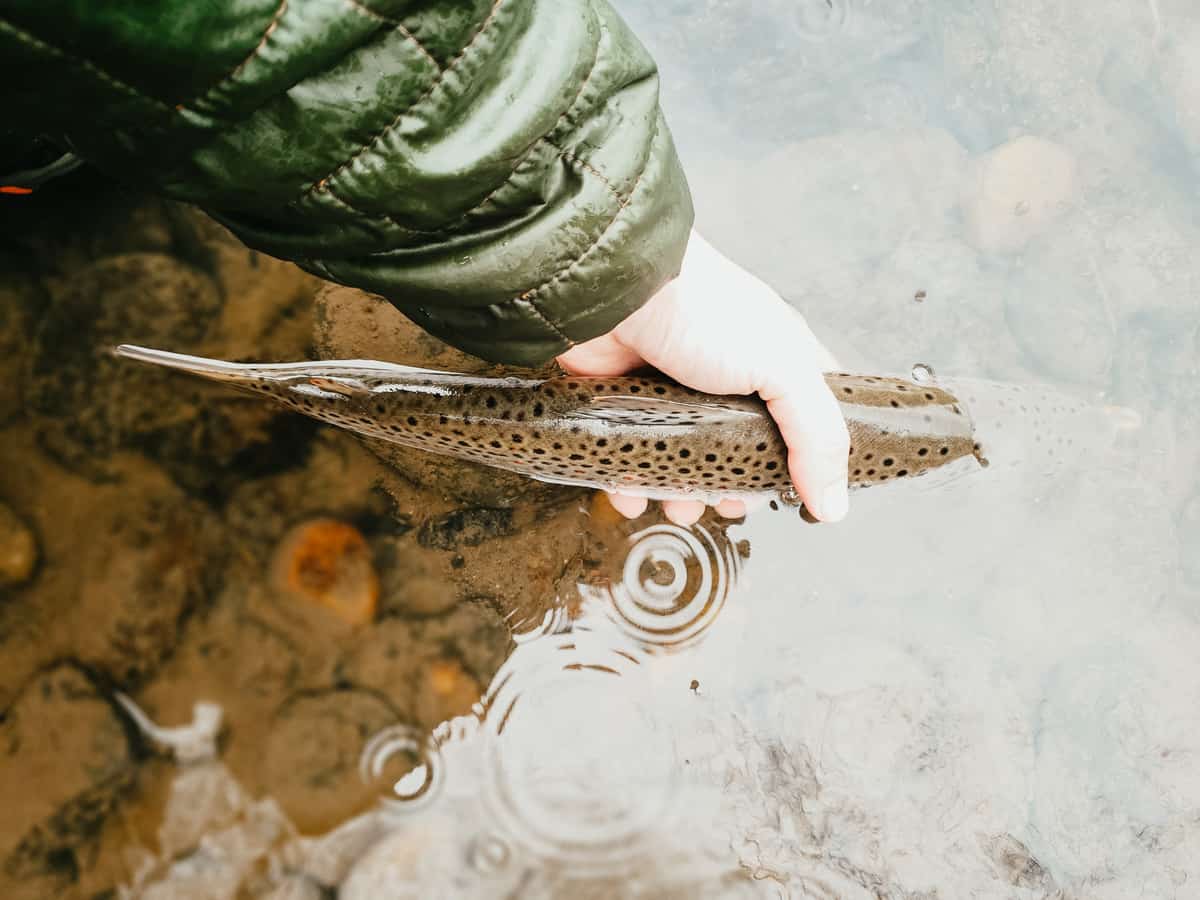
The fishing was incredible and everyone got a good number of some very shiny browns – a few confused me for rainbows actually. Chris and Rick were great students, very open to learning the techniques and I could see they got a lot out of it because of that. Their humbleness and openness to learning deeply betrayed their vast angling experience.

Rick Williams of Idaho Angler with tenkara

It was Chris’ first time tenkara fishing, and Rick had been out a few times before. I spent quite a bit of time showing them tenkara – the method – and I believe they learned a thing or two and enjoyed seeing what could be done with tenkara. The trick of the day was to pulsate the fly, a slow and controlled up and down movement did the trick for several fish.

Chris of Idaho Angler

I missed Chris’ first fish on tenkara, but it was reportedly 19-20″ (they got a picture of it, and I’ll have to post it here soon). He caught a few afterwards, with most fish being caught with a pulsating fly.

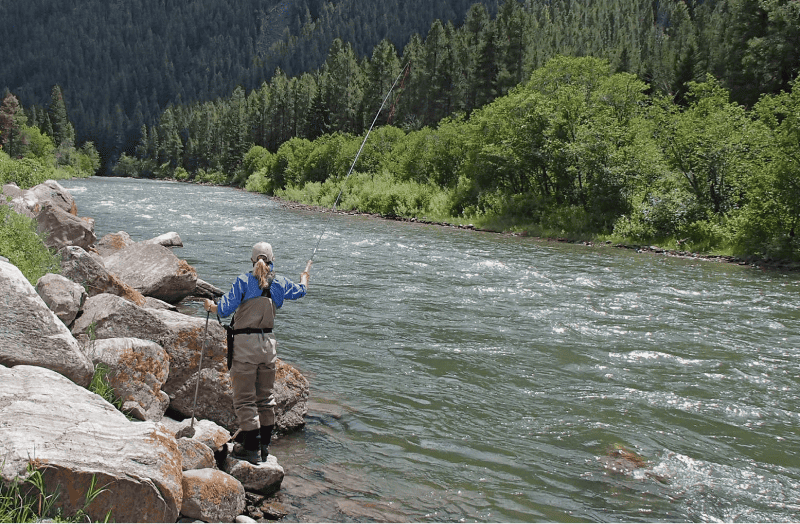
Tenkara on the Owyhee

There were small mayflies being sipped on the surface and a few large stoneflies with egg-sacks drifting around. It was interesting for Rick and Chris not to have to think much of fly patterns. Instead, throughout the day we just referred to the flies as “the large one”, “the gray one”, or “the olive one”.

I caught my first couple of fish by using the Ishigaki Kebari cast to rising fish sipping small mayflies, and at least one more on that fly afterwards. The ones cast to rising fish were caught on dead-drifts, later I caught one by pulling the fly upstream about 1ft at a time.

Ishigaki kebari on good-sized brown on tenkara

The large Oki Kebari did very well. I got a monster rise to my oki kebari as I manipulated it slowly on a slow pool by fast water. I would guess, the hump of the fish I saw, it would be a 22″-25″ fish! Chris later hooked two more that could be on that size range, using the same large fly and getting it deep by using the currents.

Tenkara bug

Print

September 06 2011

Tenkara in the Media

We still don’t even have a press page, yet articles on tenkara and Tenkara USA continue appearing in the media and are becoming more common in the US and abroad. Now, to catch up with recent mentions of tenkara in the media, there has been some great coverage recently. Thanks to those who have written about tenkara and to the magazines that have embraced talking about something so off the mainstream.

A couple of months ago French guides Yvon Zill and Guillaume Durand went tenkara fishing in New Zealand, the land of enormous trout. They submitted an article with excellent shots of tenkara fishing to the New Zealand Trout Fisher magazine. One of the shots got featured on the cover (below)! They had some other incredible shots of 20″+ in the article. Those guys have been doing a great job at spreading tenkara in France, and now in NZ! Checkout this shot:

Tenkara fishing in New Zealand

Then, our friend Tom Sadler was featured in a beautifully written story, with great photography, in Garden and Gun magazine. Despite the magazine name, this was one of the best written, and most accurate pieces on tenkara I have read so far, and the images taken were very fresh. Definitely check out the article, and the photo gallery.

Just yesterday I received my copy of Field and Stream magazine, which finally featured an article on tenkara, well written by Joe Cermele. I knew there was an article on tenkara in there somewhere, the first time I browsed the pages I couldn’t find it. And, then it struck me. The “cover” for the article was an anime-style illustration – very funny. The cover says, “How a reelless 13-foot rod is revolutionizing flyfishing”. The author went on to say, “because tenkara rods are so sensitive, I instantly felt the trout in that seam pick up the fly.” Nice!

Tenkara in Field and Stream magazine

A couple of weeks ago, right before the Tenkara Summit, I saw a post on Twitter indicating Gordon Wickstrom’s article on the periods of fly-fishing had been published on no less than the Orvis’ blog. If you read the article you’ll see that Gordon splits fly-fishing history into 6 periods. I suspect this article was partially inspired by tenkara, and Gordon asserts that we’re currently in the “New Period” of fly fishing, which is defined in part by tenkara and our introduction of a simpler method of fishing “to these shores”. I had read this article a few times before, and have the “periods of fly-fishing” table on display in my tenkara museum. But, I had a good smile when I saw it posted by Orvis. So, I posted on Twitter that, “Orvis may have just accepted that the new period of fly-fishing is marked by tenkara”, not missing a beat the folks at Orvis responded, “@TenkaraUSA I wouldn’t go that far…. ;) “. I enjoyed that exchange.

Ah, and there is Trout Unlimited. They featured a very nice article on their Trout magazine about tenkara. If you’re not a member of Trout Unlimited, please join them in their efforts to protect trout waters. Trout Unlimited has several noteworthy programs, and we support them through our 1% for the Planet commitment because of their efforts. Talking about 1%FTP, they also just released a recorded interview/podcast with me about tenkara and our 1% for the Planet commitment, in which we pledge to donate at least 1% of our revenues to environmental organizations: Podcast

And, then there was a new article at American Angler magazine, a mention of tenkara by John Gierach in his new article for Fly Rod and Reel (disclosure, I have not yet read this one, but have heard a few people mentioning it) and one for Outdoor Bozeman….

Well, a lot of catching up to let you know where tenkara is being featured. I’m thankful for all those who have taken an interest in tenkara and are helping spread the word on it. I think our sport can only gain from the acceptance of tenkara into the fly fishing communities. Maybe next time we can have tenkara on the cover of one of these mags!

Print

December 16 2009

Our 1% for the Planet Trout

As you may have seen, Tenkara USA has been a member of the 1% For the Planet initiative since its inception. Recently we also joined the World Trout program, which directs proceeds from the sales of our exclusive t-shirts to protect small stream trout habitat. Coincidentally, we later learned one of the founders of both programs, Patagonia CEO Yvon Chouinard, is also a huge fan of tenkara fly fishing, and the two other co-founders, Craig Mathews, owner of the Blue Ribbon fly shop in Montana and co-founder of 1% for the Planet, and artist James Prosek, co-founder of World Trout, are now becoming tenkara anglers themselves. We follow in their footsteps and we feel proud joining their initiatives.

Both initiatives give their members a lot of freedom to choose from among all the organizations out there, and are a good way to show commitment to the cause, rain or shine. We have chosen to focus on helping the grassroots organizations that roll-up their sleeves to protect small stream trout habitat. After much research and looking at the work of several environmental organizations in the US, we have finalized the list of the organizations we’ll be donating at least 1% of our sales proceeds, plus $5.00 from each shirt we have sold in 2009. The money coming from us won’t be huge, but we hope it does make a small difference in helping their efforts. The organizations we’ll donate to are:

The Coal River Mountain Watch: This group has an formidable task ahead of them, a long uphill battle that has been happening for quite sometime. And, outrageouly, it’s happening here. Their story is one that has outraged us the most. It really makes one feel like crying! In the West Virginia mountains, and other areas on the East coast, the practice of mountaintop removal mining has been destroying mountains, rivers, streams, and lives. This practice means that the top of mountains is completely destroyed to mine for coal. The sludge, toxic waste, debris, you name it, seeps into the ground, flows into small streams, and inevitably destroys everything and makes locals very sick. Additionally, the coal will of course then be burned – double slap on our face! A while ago I heard about their plight on the radio, the coal mining lobby is extremelly stubborn, well, they don’t believe they are doing any harm, don’t even believe in global warming, and don’t seem to give a damn about trout, small streams or the environment. We’d also like to urge you to look in this group’s plight and help if possible: http://www.crmw.net/campaigns.php

Trout Unlimited – Deschutes Chapter: TU is organized in a very interesting way, it’s a national organization split into local chapters. These local chapters can get a lot done by passionate people who live in the area. While the Deschutes is not primarily a small stream group, we have seen a lot of activity coming from this chapter of TU. They work smart and hard, and are constantly sending updates of the good work they are doing. It can be hard to find a very functional organization with good leadership and strong initiatives, but this group has been on top of it.

Trout Unlimited – Winsconsin Chapter: The TU chapter in Wisconsin is also busy with several good initiatives, and are very active. We got tipped about their work on a specific project and we liked it, they will be working on “Trout Stream Habitat Restoration for Peterson Creek” in Centeral Wisconsin. The Driftless Area of Wisconsin is the primary center of attention for small stream protection, and receives a lot of funding for projects, while other streams are sometimes left aside. We feel that no stream is too small and no stream should be forgotten, so we’ll be helping this specific project.

Our decision to donate a small part of our sales to the environment was based on one simple fact: we’re making money from clients who enjoy their time outside, and we feel we should be directing a self-imposed tax for the purpose of protecting their small streams. The reasons are as much idealistic as pragmatic: (1) We want to ensure our business will be viable in the long term and we feel strongly that we need to protect the resources and the environment where tenkara anglers will go fishing, (2) we have seen the lack of support by our government, and by our own industry, and we need to do our part. It’s the least we can do, very simple really!

I recently read an article on a fly-fishing industry magazine that was giving marketing tips to companies in the industry, among other points it said: “Join the ‘Green’ scene. It’s the latest marketing craze. Create a program that addresses ecology and be public about it.” While encouraging companies to join the “green scene” is a great thing, I think that surperficial reason misses the point completely and makes joining the movement a “chore”, not a idealistic decision. Such reasons, in our opinion, are not long-term commitments. A change in management, or a time of little money (say a recession), and the commitment evaporates. We write about what we are doing to increase awareness about the programs we feel are important, but the decision to participate in the “green scene” should be based on something more fundamental than marketing: we just need to do our part and pay something back to protect what our industry depends upon. We just need to protect what we use!

Print

June 01 2009

“The New Period”: fly fishing simplicity

One of the main reasons most anglers are attracted to tenkara fly-fishing – whether a tenkara veteran such as Dr. Ishigaki, or any of the recent adopters of tenkara – is, simply put, simplicity. That draws some to add it to their repertoire, and makes others leave their reels behind permanently. That is also the reason we have fallen in love with tenkara fly-fishing to begin with.

In his column“Gazing into the future of angling in America”, writer Mr. Gordon Wickstrom defines the two most current eras of fly-fishing: “The Trout Unlimited” period, and now, “The New Period“:

Now the fishing that remains to us– I’m going to call it “The New Period”– will be marked, I think, by greater simplicity of gear, technique, style and purpose. It will be done closer to home, more impromptu and with less media attention. It will be gentler, more elegant, and less aggressive — in some ways more old fashioned…
There’s my new friend in San Francisco who is introducing the tackle and practice of Tenkara, an ancient Japanese method of fishing the fly with a long, reel-less rod and short line.
It is a method of the same values as we envision for our new national life … For me, Tenkara is a sign of the times.

From the beginning, the vision behind Tenkara USA has been to show the simplicity inherent – although long forgotten – in the art of fly-fishing. We have not yet ellaborated much on our philosophy, but, in sum, it is:

    “fly-fishing is simple”

…..don’t let them fool you.

Print