The Tenkara USA guarantee means we’ll make sure your tenkara rod bearing our name gets fixed quickly and conveniently. Do not mail anything back to us, we will send you just the part(s) you need for your tenkara rod. […]
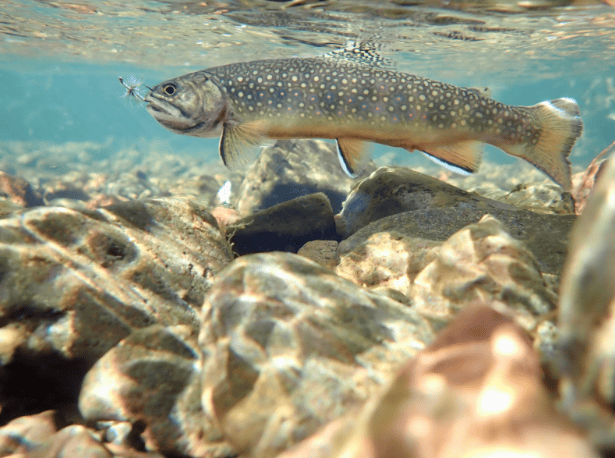
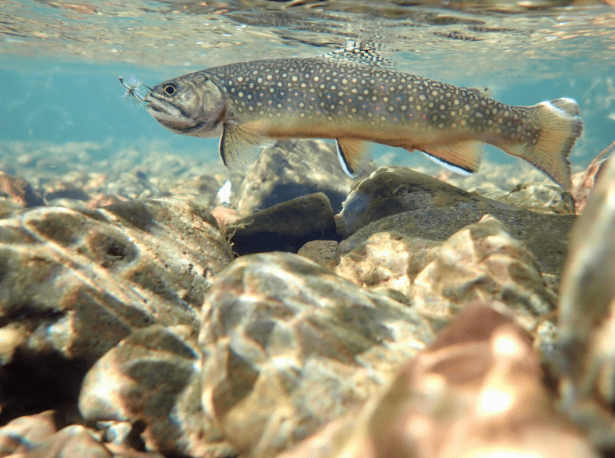
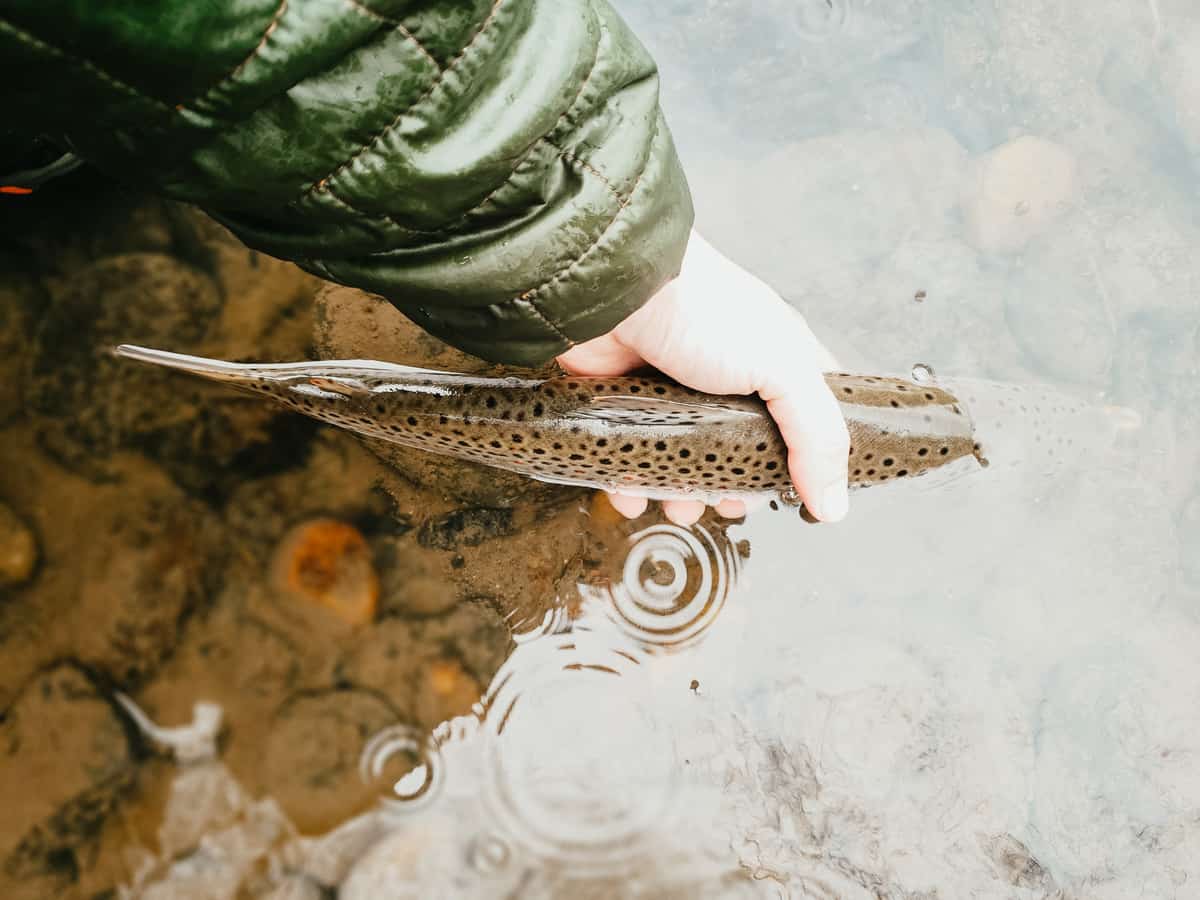
This is the photo of a Japanese char, the Iwana, which I took on one of my trips to Japan. Iwana translates roughly as “rock fish”. Aptly I caught this guy on the Tenkara USA Iwana rod. It is said they can “walk” on rocks to get back to the water, and legend has it that they can use that ability to cross paths and get on different waters if their stream is drying up. I can vouch that they can use their fins to stand, though I haven’t yet seen one walk from one stream to another.
The number one question we are asked by new tenkara anglers is, “which rod should I get?” It certainly can be confusing since tenkara rods come in different lengths and actions. We always like to tell people that they really can’t go wrong, any rod will work just fine. But, in order to assist you with understanding what our rods are designed for, we have put together the video below with Daniel walking trough the entire lineup of Tenkara USA rods. We have also put together the chart below the video, which we hope will help with the decision making process and some pointers about the key aspects of tenkara rods.
Since all Tenkara USA rods will work for most trout fishing and smaller fish scenarios it’s hard to pin each one down to a specific use or to match your exact preference. Further, we believe people will just grow into the rod they get anyways.
It was never our intent to make things more confusing, nor necessarily for people to buy multiple tenkara rods when we developed the 6 rods that are in our current lineup – as a small company things would be MUCH simpler if we only had to worry about managing inventory of one rod model. But, each of the rods in our lineup were developed to fill a specific niche or preference. However, there are certain applications where we believe each model shines and the following table attempts to simplify the rod selection process:
Three Easy Choices
If you wish we offered fewer options, you can easily narrow the choices down to 3 “all-arounder” rods: the 13ft-14ft7in Ito, the 13ft Ayu, and the 12ft Iwana.
These rods are very easy for us to recommend, with the other rods in the lineup being considered more “specialty” tenkara rods.
The main difference between the Ito, Ayu and 12ft Iwana will be their length. So, if you fish wider streams and are looking for an excellent premium rod the Ito will be a great choice. If you’re fishing wider streams but don’t want to spend as much money on the rod, the 13ft Ayu is a great option. And, if you fish a mix of stream sizes, the 12ft Iwana is a great no-brainer.
If in doubt: just get the 12ft Iwana.
Bigger Fish – two more choices
We have developed two rods with more backbone if you’re always catching fish that are 17″ (43cm): the 12ft Yamame and the 13ft 6in Amago have more backbone and make landing the larger fish a bit easier. The main difference between the two is their length, with the Amago being a better rod for larger and more open streams, and the Yamame being the best tool for smaller streams.
Smaller Streams – one more choice (erhh, two actually)
The last choice in our lineup is if you’re fishing pretty small streams all the time. In that case we offer the 11ft version of the Iwana. You’ll have less reach, but if you’re fishing tighter streams that will be a good choice.
Actually, if you get the Iwana, you also have the option of purchasing a separate add-on handle to transform your rod into its shorter cousin. We only recommend you take advantage of this option after you have been fishing with tenkara for sometime and REALLY wish you had a shorter rod. In our experience it just takes a little getting used to the longer rods, but once you’re used to them they will likely work well.
Some further thoughts on what how we make our recommendations
Length, start here
The first question you should ask yourself is which length is right for the majority of fishing you plan to do. Generally speaking, we always recommend using the longest rod you can get away with. This will give you more reach, help you keep more line off of the water and give you more control over your fly (one of the main benefits of tenkara).
A 12ft (360cm) tenkara rod is a very standard length for tenkara. But, if you live near pretty small streams with low, overhanging branches, then a shorter tenkara rod (say 11ft / 330cm) might let you cast more easily under the canopy.
In either case, you should target your rod choice toward the waters you’ll fish the most. AND, keep in mind a longer rod will have the added versatility of giving you reach in more open sections of a stream, while having the ability to be “fished shorter” by holding the rod above the handle and potentially even collapsing one segment. Further, pairing a long rod with a short line is a very effective combination in smaller streams. Both Jason and I usually fish a 13ft tenkara rod (even on small streams) and you might be surprised how well it fishes in pretty tight quarters.
Action, this is more subjective
Action is primarily a personal preference. Some people prefer stiffer rods, while others prefer softer actions. There is no right or wrong here.
We tend to prefer softer rods (5:5 or soft 6:4) because they load easily, making for very effortless casting. Softer rods will also protect tippet well. Our rods will lean towards the softer end of the scale as we believe they are the best tool for tenkara. Two of our 6 rods are stiffer. The stiffer rods will often have more backbone to put pressure on large fish and will be better at precise casting at short distances (though this can be made up for with technique and practice). The Yamame and the Amago, are both stiffer and also have a good deal of backbone and were designed with larger fish in mind.
Tenkara rods are relatively soft compared to western fly rods, and all our rods have soft tips to assist in casting very light lines. So if you’re used to a fast-action western-style fly rod, you might prefer a slightly stiffer action tenkara rod like the Iwana 6:4, the Yamame 7:3 or the Amago 6:4.
Fish Size, last consideration
All tenkara rods are made for the average trout and other smaller species of fish: 8″ – 18″ (20 – 45cm).
All tenkara rods will handle the occasional 20+ incher (50cm +). So, if your targeted fish size is within those ranges, fish size should have little bearing on the rod choice: ANY ROD WILL WORK FINE.
If you’re constantly catching fish that are over 17 inches (43cm), then we have two tenkara rods that have more backbone (stiffer and with more mass): the Yamame and the Amago. We consider those more specialty rods and they sell very well in places like Montana and Idaho.
With each rod being so versatile, it would be hard to make the “wrong” choice. Hopefully, the chart and video above will help. If you’re still struggling with which rod is right for you, feel free to post here, or email Jason at Jason@tenkarausa.com. He will be happy to help you make the best decision on your first tenkara rod.
A picture I took while in Japan has been receiving a lot of comments on Facebook, so I thought I would share that here today.
This image was taken in a remote mountain stream in Japan, while engaging in the activity they call “shower climbing”, where, dressed in wetsuits and sporting climbing equipment, we rappelled some waterfalls and climbed others in the pursuit of rare native Iwana.
At this particular spot I found myself alone, but with a gorgeous background. Not to miss the moment, I used the self-timer, placing the camera on a rock, and trying to make my way to the rock I had been fishing from a few moments earlier. The fish in this session eluded me, but the spirit of the adventure was certainly captured.
This adventure inspired me to write a full story, which I titled “In Search of Tenkara” and is the main feature story in the upcoming issue of The Fly Fish Journal. So, keep your eyes open, we’ll make a big announcement when that issue is out in the next couple of weeks.
By the way, here’s the reason we had to wear the wetsuits:
Over two years ago my friend Masaki and I went fishing together to shot the first video for this website. It was then that I was exposed to my first glimpse of a rich tenkara culture, and a part of it that has become some kind of a ritual in my outings: kotsuzake, a drink which requires only sake and the lightly charred bones of an eaten fish.
Kotsuzake, to me, is underpinned with ceremonial and philosophical significance – though you should not picture a tea ceremony here. It is primitive and raw. The bones of the precious trout, after being separated from the meat, are placed over the coals of the fire and lightly roasted to bring out oils and flavor, after which they are immersed into the warm sake. The result is sake with subtle and tantalizing fish flavors, and a practice that is a personal routine if I must eat a trout that I catch.
The only way I ever prepare trout nowadays is with a simple coating of sea-salt over its skin, what is called “shioyaki” (or salt-grilled). The trout is skewered firmly, with a skewer never puncturing its flesh until the end. The absence of other seasonings, only salt enhancing its flavor, and the skillful use of a skewer preserving the integrity of its flesh are the best way to honor its meat.
Small trout from a fish-farm in Japan, lunch for 5.
Kotsu means “bone”, zake is just a modified version of “sake”. However, while the traditional drink, and even the drinks’s name imply the use of the bones only, another common way of drinking it is to use the entire fish, cooked, and submerged in sake. The correct name for that being “Iwanazake“, after the fish more commonly used for such a drink the Iwana. I have not yet tried this way of drinking it, thinking of it as a waste of trout.
In the mountain areas I spent time in, kotsuzake made this way (whole fish) is somewhat a staple. In a few local farmers’ markets I even found the neat prepackaged kotsuzake sets of the picture below. The package on the left side contained a piece of hollow bamboo that would serve as a cup along with a dried Iwana. The instructions illustrated heating the fish, putting it in the container, and finally pouring sake over it. The one of the right, I have no idea, I gave it to a friend as a gift. It looked like a cup with pieces of dried Iwana, not the entire fish. When shaken, it rattled. The package was neat, a good souvenir.
Preparing and drinking kotsuzake, is an act of homage to the principle of not wasting the resources that nature provides. I wish I had a better, cleaner picture of kotsuzake. The image below, in contrast with the sterile packages above, will automatically make you think “disgusting!” As I said, it is primitive, particularly when done stream-side. However, do not be taken back by it, it tastes much better than it looks. The ritual feels even better.
After the incredible surge in demand over the last month we quickly sold out of one of our most popular rods, the Iwana 12ft. To meet the on-going demand we brought back some of our series I Iwana from the Canadian warehouse. These were just added to our inventory and will be available until sold out, probably within the next 2 weeks.
If you had been waiting for the 12ft Iwana, now’s the time to get it. This is the first iteration of the Iwana rod, which has a shorter handle (9 inches instead of the current model 12″ handle). It’s a very nice rod, and what created the following for the Iwana. The Series II, which has a longer handle, and better quality cork, is expected back in our inventory approximately the first week of May.
While Tenkara USA is a fully independent company with no commercial ties with a Japanese company, we are very fortunate to have established very strong relationships with tenkara masters in Japan. These relationships, particularly with our masters Dr. Hisao Ishigaki, Yoshikazu Fujioka and Sakakibara Masami (aka Tenkarano-oni) can be seen in every single one of our products, and is something no other tenkara company can enjoy. That is our true competitive advantage.
Today I’m happy to release our redesigned Iwana tenkara rods. The Iwana is currently our best-selling rod, and redesigning something that is working that well is always a risk. However, this rod incorporates meticulous feedback acquired from tenkara anglers in our last visit to Japan. The feedback was honest and important enough to warrant the tweaks we made. The main focus of this release was the new handle design. The handle is probably the most important design component of a tenkara rod. It provides comfort for a full day of constant casting and manipulating of the fly and balance to the rod. Our new design allows the angler to comfortably grip the rod in different positions, including the very end of the rod with a rounder finish. This new release also features better quality cork, a longer handle (unanimously suggested by all tenkara anglers we met in Japan for improved balance), and a redesigned metal cap which will not come loose while fishing.