Warehouses in the USA and the UK for shipping within the European Union quickly and with no customs.

FAQ - Choosing a Tenkara Rod - Forum

About Tenkara Tenkara Rods tenkara lines tenkara videos tenkara flies

April 25 2012

We want product reviews!
Will give prizes for honest reviews

We just released a new feature on this site: Product Reviews. But, the reviews are trickling in slowly. We really would like for you to review the products you have tried to help future tenkara anglers know more about our products.

To give you an incentive we’ll be giving out a lot of prizes for your honest review. All you have to do is log on to our site, go to your favorite product, and writeup a review before May 10th.

DRAWING: Every review has an unique id, we’ll use a random number generator to pick the winners – reviews already entered will be included in the drawing. The more products you review, the more chances you have to win though, of course, we only want reviews of products you know. The review should be honest – no special consideration will be given to content.

Ah, “what prizes can I get?”, you ask.
So, we will make this very sweet for you and give plenty of stuff away:
1) Complete tenkara set (two will be given)Any tenkara rod you want* along with a traditional tenkara line, tenkara level line, 2 tenkara line holders and set of flies. *rod subject to availability but all should be in.
2) Tenkara net *(US ONLY) (1 will be given).
3) A new tenkara bamboo fly box valued at $63 (1 will be given).
4) Copies of The Fly Fish Journal with Daniel Galhardo’s article on tenkara and his visit to Japan. (5 will be given)
5) Tenkara Sakasa Kebari T-SHIRT (2 will be given).
6) Tenkara baseball cap (2 will be given)

DEADLINE: May 10th. Winners will be selected within a couple of days from May 10th.

Print

April 20 2012

Manzanar Fishing Club (Movie)

Manzanar Japanese angler with golden trout

Quite sometime ago we talked about the beginnings of a fascinating film project, the Manzanar Fishing Club. This project documents the stories and history of Japanese and Japanese Americans who were imprisoned at the Manzanar internment camp (Eastern side of the Sierra Nevada) but would risk their lives to sneak out of the camp and pursue freedom in some moments of fishing.

We’re happy to share that the film has been completed and is opening soon in several theaters. I had the pleasure of watching a pre-opening showing a couple of months ago and it is a touching story that is very well told by the film-makers and those who tell us their personal stories.

Manzanar Fishing Camp film schedule

The angler pictured above was an angler from Japan who would disappear for days at a time to go fishing in the mountains nearby. In this particular stance he was gone for 2 weeks, leaving the camp with absolutely nothing on him, and for 2 weeks surviving off the harsh terrain of the Eastern Sierras. The fish he proudly displays are golden trout, which were only found miles and miles away from the camp.

We will never know whether he, or anyone else who suffered the injustice of being imprisoned, was aware of tenkara or not. It is actually irrelevant. If tenkara really means from heaven, then I’m certain they practiced their tenkara. Those who fished outside the camp found their tenkara, their moment of freedom and their gift from heaven, on the streams on the other side of the barbed wires.

Print

April 13 2012

George Elliott Gregory, first mention of tenkara?

Following my post on the first record of tenkara by Sir Ernest Satow, I received a response from Kevin Kelleher, author of the book Tenkara: Radically Simple, Ultralight Fly Fishing. I post his response below, and a few of my remarks on the bottom of this post.
I should have made it more clear on my post that Gregory’s writing could be of tenkara. However, as Gregory’s descriptions are vague and not very detailed (he does not mention where he saw it, nor what fish was being caught), it is difficult to conclude whether he was observing tenkara or a different method of fishing. Satow’s writing, on the other hand, is certainly describing tenkara and for this reason Japanese scholars give credit to Mr. Satow for the first record of tenkara. The most interesting thing, regardless of who first observed tenkara, was the fact that the method was likely practiced in Japan for a few hundred years, yet the first records appeared less than one year apart.

By Kevin Kelleher:

Though likely no one can prove unequivocally the first English reference to tenkara, I think you dismiss the discovery of George Elliott Gregory’s 1877 description in the Transactions of the Asiatic Society of Japan too easily. Let me defend.

First, Mr. Gregory’s report to the Society was in his own words “a thorough consideration of the subject of the fisheries of this country,” and includes a broad if not comprehensive description of at least 20 fresh water fishing techniques from hand line and net, to trap and cormorant fishing, in “lakes, rivers, and preserves.” One would anticipate that a “thorough” report to an academic society cataloguing fishing techniques in the “preserves” might contain an early reference to tenkara and Mr. Gregory states he has been studying the subject “for some years” in many different parts of Japan.

Second, the length of the rod in question is described as being between the 21-foot koi-tsuri-sao, and the 3 ½ foot haze zao, which at least fits the bill. More importantly, Gregory describes the rod in question as “a simple bamboo rod.” This resonates with my thinking on early tenkara rods, and Gregory himself contrasts this with multi-sectioned rods, lacquered and bound with silk found on other waters, and known to be used in Ayu fishing.

Further, Gregory calls both the rod and the fly it casts, Ke-bari. The undeniable explanation of the action of the kebari (the fly) seals the deal for me. Gregory describes the wings (sic. Hackle) as being rough and rigid when compared to European flies and made so they are able to “resist the pressure of the rapid streams of the country [so they do not] collapse and thus cause the artificial fly to lose all similitude to the real insect.” Surely this is a reference to the traditional tenkara fly. Mr. Gregory’s specific reference to “the rapid streams of the country” makes the description unlikely an Ayu fishing reference, which was practiced in larger rivers nearer urban areas. Later in his report he spends several pages on a translated work, describing the cormorant fishing for Ayu including recipes, implying he likely knew the difference.

In summary, Gregory’s description is a scholarly report of a fishing technique using a medium sized, simple, bamboo rod, fishing a kebari, whose hackle is designed to resist the high gradients, of the rapid streams of the country. Pretty convincing, I think.

(As an aside, Gregory presented this report to an open meeting of the Society, and since Sato was a founding member, would very likely have been in the room at its reading.) In the end though, it will be admitted, that neither Sato or Gregory were anglers, hence we shall be forever dissatisfied. As I said in Tenkara, the origins will likely remain a mountain mystery, which suits me just fine. More importantly, the friendly banter between tenkara enthusiasts in this uniquely open community should continue, God willing, as long as clear mountains streams dance with fish.

Cheers,

Kevin

Notes by Daniel:
Just a few points:

1) Gregory chose to describe 5 methods: koi-tsuri-zao, ka-bari, nagashi-bari, dzudzugo and te-zuri. He writes ka-bari, not ke-bari. Ka is the word for mosquito, and is still used to describe the flies used in ayu fishing. Tenkara flies are not reffered to as ka-bari. This was something I discussed with Mr. Fujioka, who researches tenkara flies, when I was in Japan. He gave me a set of ka-bari, which are used for ayu-fishing because he thought I would be interested, but said ka-bari are not used for tenkara.
2) On the flies, he does mention they are stiff, but we’ll never really know if he was referring to tenkara flies or ayu flies. Here’s an image of an ayu fly. Some ayu flies are stiffer. Likewise, some tenkara flies are stiffer than others. Also, it is more common to see ayu flies made with bristles than tenkara flies. Not an overly important clue, I do not think.
Ayu fly
3)” “the rapid streams of the country” makes the description unlikely an Ayu fishing reference, which was practiced in larger rivers nearer urban areas. ” Ayu fishing is also done in what can be perceived as rapid streams. While more popular in some of the lower rivers, it is also done in higher faster streams. For example, this picture was taken in Gujo, Gifu, an area that would have been easier for him to reach and observe ayu fishing: , which is still plenty fast for someone who may have grown up by a chalk-stream. Ayu fishing was a big thing where I was living, and was done also on the Mazegawa, which is a great tenkara river. When the ayu season opened, this section was full of ayu anglers:

Print

April 11 2012

Diaries of Sir Ernest Satow
First records of tenkara (History)

The original tenkara angler was generally illiterate, and truth-be-told, not at all interested in making a record of his time fishing. It took a British diplomat, spending time in Japan, to write on paper what has come to be accepted as the first record of tenkara.

Mr. Ernest Satow, a British diplomat who spent over twenty years in Japan at the prime of his career and who was also a keen mountaineer, kept detailed diaries of his time in Japan. In his records of the years 1877 and 1878 we can find the first references to tenkara ever recorded. The references did not mention tenkara by name, simply the fact that flies were being used to catch the local trout.
Diary of Mr. Ernest Satow tenkara iwana kebari artificial fly
Based on the detailed descriptions in his diary, his records are the first that most likely indicate the observation of tenkara.

It was stated in Tenkara: Radically Simple, Ultralight Fly Fishing by Kevin Kelleher and Misako Ishimura, that the first description of tenkara was written by George Elliott Gregory on March 28, 1877. I do not believe, that Mr. Gregory was the first person to observe and write a record of tenkara. Mr. Gregory wrote a report titled “Japanese Fisheries” for the book Transactions of the Asiatic Societies of Japan. In his report, Gregory describes five methods of fishing practiced in Japan, one of which he calls ka-bari, where ka is a word for “mosquito” and bari is the word for hook. He writes, “The ka-bari is a simple bamboo rod. The line is used with a float but without any sink and the bait, as its name ka implies, is an artificial fly.” However, based on the vague description, and the fact that he does not mention the area where he observed this type of fishing, nor the species targeted, we can not be certain whether he was referring to tenkara or another method of fishing. Japan has an abundance of fresh-water fishing methods, at least two of which use flies (ayu fishing and tenkara). As tenkara was primarily practiced in the higher mountain streams, and ayu fishing much more common and at easier reach, it would be difficult for him to have observed the method. Furthermore, ayu fishing is normally referred to as “ka-bari”, not tenkara.

Mr. Satow, on the other hand, was in a good position to have witnessed tenkara first-hand. he frequently visited the areas far off the beaten path in Japan, and more importantly, spent time areas where tenkara would have been practiced. On numerous occasions he visited the mountains in what is now known as the Japanese Alps, with numerous mentions of Mt. Tate (or Tateyama) and Mt. Ontake. These areas are known for their cold streams and the long history of tenkara practice.

On September 22nd, 1877 Mr. Satow writes about his time near the river Katashinagawa (gawa = river), “Bears, deer, wild boar & hare taken in the winter months; yamame (trout) with artificial flies.”

Then, during a period of about ten days in 1878, Mr. Satow wrote three passages on his experiences around Tateyama and Mt. Ontake:

July 23 1878: “…Height about 7500 or 8000 ft… Below the top large yellow ranunculus 3 & black lilies in abundance 4; then rhododendrons in flower… Magnificent rocky cliffs tower above us all the way to the first hut at Futamata, then the sides of the ravine slope more, and are generally covered with trees. The ice cold stream boils along over rocks of grey granite, & so cold is it that in crossing one bridge we actually feel the consequent change of temperature.”
July 24, 1878: “Last night we had for dinner capital fish called iwana [a native Japanese trout], caught in the Kurobe-gawa with a fly made of cock’s feathers, weighing about 3/4 lbs.”[2]
July 28, 1878:”Our coolies[3] were provided with bamboo rods and flies to fish for iwana in a stream near Kamidaki.”
August 3, 1878: …”Fish caught in this stream iwana and tanabira, and artificial flies are used. From here to the top of [Mt.] Ontake is 7 ri.”[Edited by Ruxton, Ian. A Diplomat in Japan Part II: The Diaries of Ernest Satow, 1870-1883. Lulu Press Inc. September 1, 2009

One note: I have mentioned in this blog before that the first record of tenkara was in a book called "Diary of Climbing [Mt.] Tateyama”. This was a compilation of Mr. Satow’s diaries done in Japanese. Mr. Satow himself never gave his diaries that title. Thus, it is more accurate to state the first record was in Sir Ernest Satow’s diaries.

The full transcripts of Sir Ernest Satow’s diaries can be acquired and read in this pdf version of the book. The diaries themselves are a fascinating read for those interested in Japanese travel.

Ah, just as a reminder: tenkara was never practiced by samurai.

[1] From Japanese scholars, I heard of the existence of a book called “Diary of Climbing Mt. Tateyama”, but besides hearsay I could not confirm its existence. Diary of Climbing Tateyama (立山登山日記)
[2] [Note: the Kurobe river is not far from Tateyama, which is mentioned later in the same entry.]
[3] It is thought his guide in this areas was Mr. Shinaemon Toyama

Print

April 09 2012

Tenkara lessons from 6-year old Jack

On my last post I said the off-topic post would not set the precedent to talking about funny cats. But, I could not have predicted the future. In this hillarious video, 6-year old Jack (son of John, from tenkaraguides.com) gives us some great lessons on tenkara, covering the importance of casting accuracy, enticing a take, fly manipulation and how to land a fish.


Print

April 08 2012

Wasatch Fly Fishing Expo

This weekend we participated at the Wasatch Fly Fishing and Fly Tying Expo. It was very much a last minute decision to attend. The Tenkara Guides of Utah were participating, as was Craig Mathews from Blue Ribbon Flies (one of our dealers and very passionate tenkara angler). Also, Utah is one of the states with most potential for tenkara, with lots and lots of streams in the mountains nearby but where, by perusing the main online forum for fly-fishing in Utah, it seems like many people have the wrong ideas about the method. Thus I decided to come in and help tenkara take over the show. It turned out that we did make a big splash, and introduced tenkara to hundreds of people and “converted” a good number of them. It was hard to look at our corner and not see a crowd. Several people commented that we were keeping people in that area for too long. So, tenkara has now made big strides in Utah.

A big thanks to Josh Leavitt of Rutalocura.com and Holga photographer Brian Schiele who helped at the booth.

Tenkara USA Booth at the Wasatch Fly Fishing Show

Also, a huge thanks to John and Rob of tenkaraguides.com for their enthusiastic participation at the show. Having their booth next to ours provided huge synergy.

It was also great seeing many advocates stopping by and talking tenkara to anyone who came near our booth. Several people said they came to the show specifically to see tenkara. If there is something that makes me truly happy it is to see those who adopted tenkara come to say hi and then hang out talking to everyone about their newfound passion.

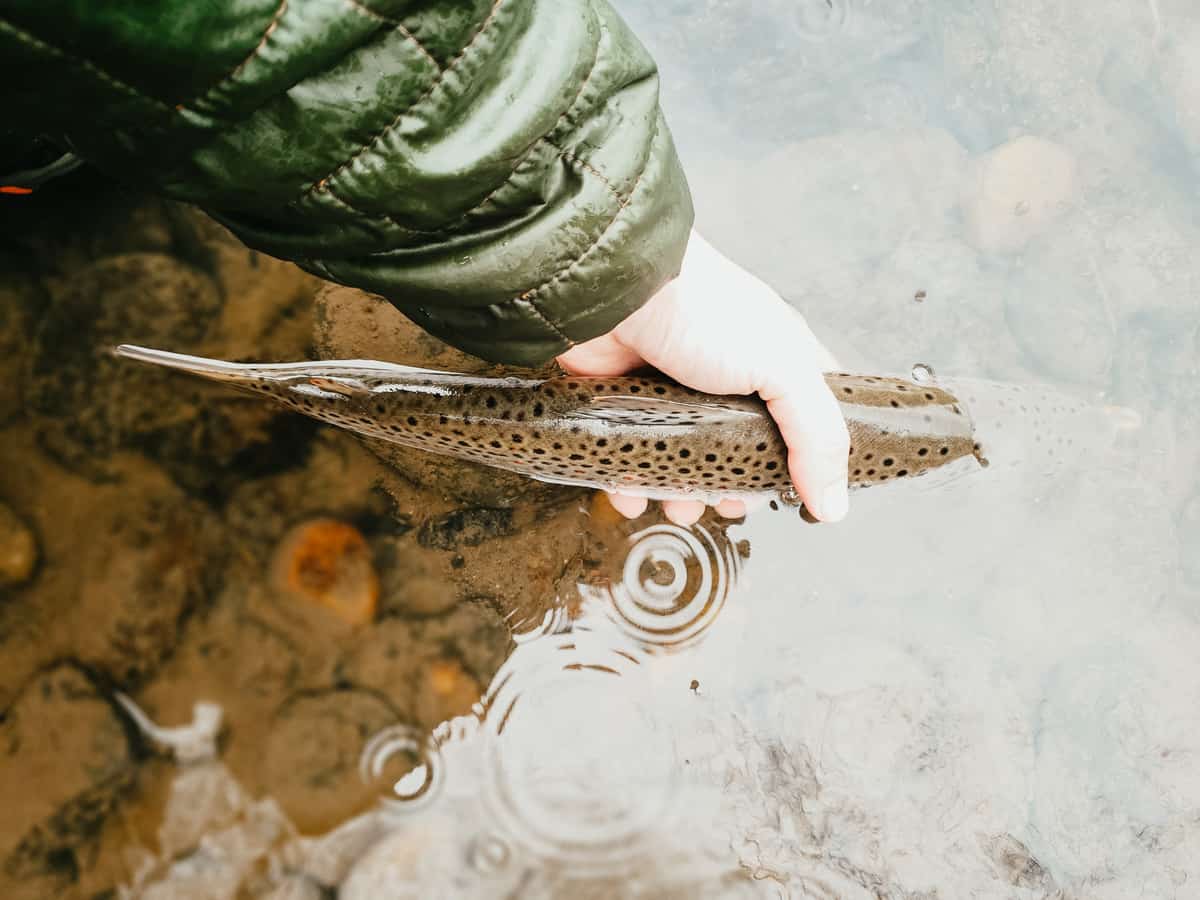
The day before the show John and I went fishing at one of the Cottonwood canyon streams. We only had a bit over an hour of fishing time and I landed a beautiful brown trout. Using an ishigaki kebari of course. We fished a small stretch without a bite. The temperature the day before had swung dramatically: t-shirt and shorts weather when I arrived, but a nano-puff jacket and gloves when we went fishing the day after. Caught it by casting upstream and getting my fly to sink a few inches on a small plunge.

brown on ishigaki kebari tenkara fly

In a couple of hours we’re heading to a new-to-me stream outside of Salt Lake City, and I’m truly excited to see what that holds. The tenkaraguides.com couldn’t stop talking about it last night. I think they know something most people here don’t.

Print

April 02 2012

Camera phone microscope: optical lens for you entomologists

For the first time I’ll be taking the liberty to talk about something that is not totally related to tenkara, but which I think you’ll enjoy, and which may have applications in tenkara too. Do not worry, this will not be setting a precedent for posts about funny cats in the future. I believe you’ll like learning how to turn your camera phone into a microscope.

Read the rest of this entry »

Print